Indonesia is feeding 83 million people for $0.62 a meal, a case study in how fast welfare can scale (and break)
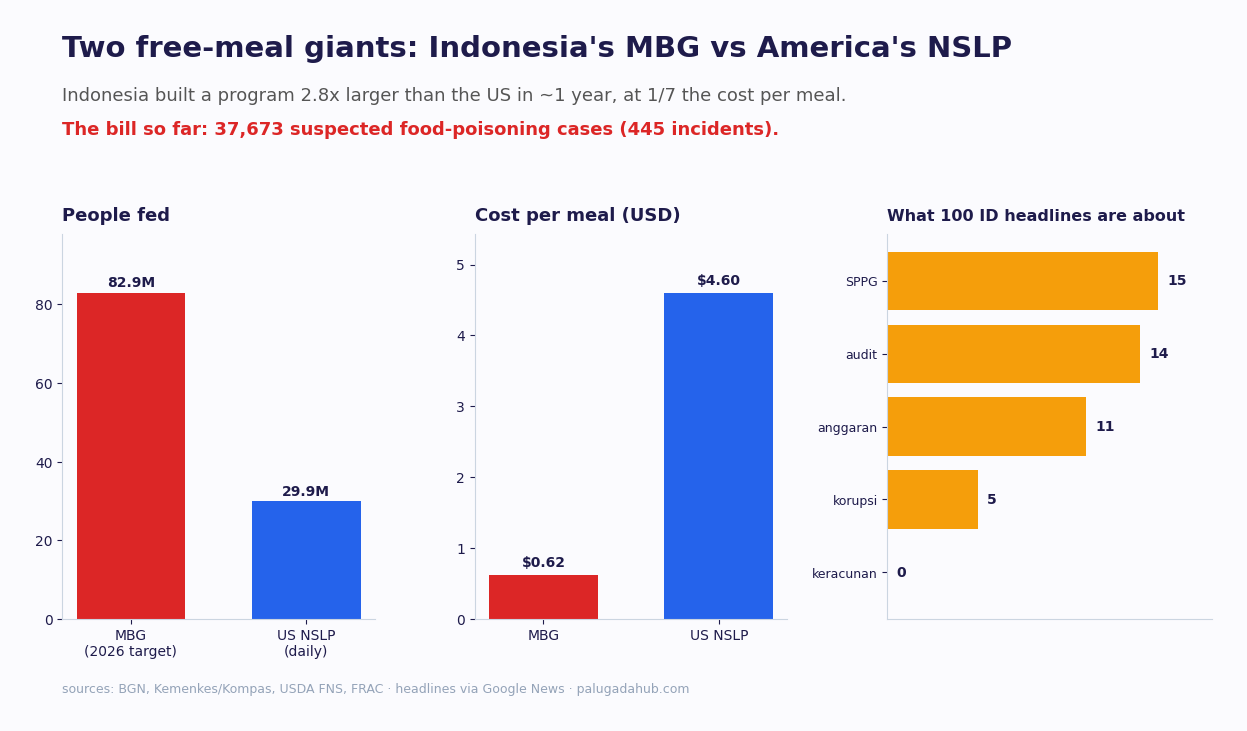
Most welfare programs grow over decades. Indonesia's Makan Bergizi Gratis (MBG) tried to do it in one year, and is now feeding more people than America's school lunch program built over 80. I pulled the numbers on both, plus 100 live Indonesian headlines, to see what hyperscaling a social program actually looks like.
What
MBG is Indonesia's free nutritious-meal program for students, toddlers and pregnant mothers. The 2026 numbers, against the US National School Lunch Program (NSLP):
- Reach: MBG targets 82.9 million people in 2026 (≈59.9M already reached). The US NSLP serves 29.9 million students a day.
- Cost per meal: MBG runs on Rp10,000 (~$0.62) a portion. The US federal reimbursement for a free lunch is ~$4.60, roughly 7× more.
- Budget: MBG is allocated Rp335 trillion (~$20.9B) for 2026, spending ~Rp1.2T a day. NSLP cost $17.7B in FY2024.
- Age: MBG is ~1 year old. NSLP has existed since 1946.
And the part the brochure leaves out: as of 10 May 2026, Indonesia logged 445 suspected food-poisoning incidents and 37,673 victims tied to MBG meals.
Why it matters
This is the clearest live case study you'll find on the speed-vs-safety tradeoff in public policy. Indonesia proved you can stand up a continent-scale feeding program in months. But cost-per-meal that low, scaled that fast, runs ahead of the boring infrastructure that keeps food safe, most kitchens (SPPG) still lack hygiene certification, and cooked meals reportedly sat at room temperature for 7-8 hours, well past the WHO's 4-hour limit. The dynamic isn't "corruption" (though that's alleged too). It's that logistics and food safety don't scale as fast as political will.
Who it's for
Anyone watching how emerging economies deliver welfare at scale, policy folks, founders building for the next billion, and Indonesians trying to separate the program's real wins from its real failures.
When & where
This is happening now, nationwide. My read of 100 current Indonesian headlines shows the conversation has already shifted: the loudest themes aren't the launch hype anymore, they're SPPG kitchens halting (15 mentions), audits and evaluations (14), and budget cuts/efficiency (11). The state is quietly walking back ambition: the food agency signaled it may trim 8 million beneficiaries next year.
How
The comparison data is all public. Indonesian figures from BGN (the food agency) and Kemenkes via Kompas/IDN Times; US figures from USDA FNS and FRAC. The headline-theme scan is a simple regex over the Google News RSS feed:
import urllib.request, urllib.parse, re, html
q = urllib.parse.quote("Makan Bergizi Gratis")
xml = urllib.request.urlopen(f"https://news.google.com/rss/search?q={q}&hl=id&gl=ID&ceid=ID:id").read().decode()
titles = [html.unescape(re.sub("<.*?>","",re.search(r"<title>(.*?)</title>",it,re.S).group(1)))
          for it in re.findall(r"<item>(.*?)</item>", xml, re.S)]
# then count theme keywords: audit|evaluasi|setop, anggaran|pangkas, sppg|dapur, korup, keracun
Honest caveats: the comparison isn't perfectly like-for-like. MBG's 82.9M is a 2026 target across multiple groups; the US 29.9M is daily students. Indonesia's Rp10k is a production cost ceiling; the US $4.60 is a federal reimbursement rate, not the full cost. Different definitions, but the order-of-magnitude gaps (reach, cost, maturity) are real and they tell the story.
The takeaway
You can scale a welfare program faster than you can scale food safety. Indonesia is finding out what that costs, 37,673 cases and counting, in real time.
Data: BGN, Kemenkes/Kompas, IDN Times, USDA FNS, FRAC. Headline themes: Google News RSS (100 items), June 2026. Chart and method reproducible.
Building an AI agent?
I'm packaging how I ship them into one kit. Early access:
AI Agent Starter Kit →