I compared free-meal programs in 4 countries. The weird part: Indonesia spends 15x India's budget to feed fewer kids
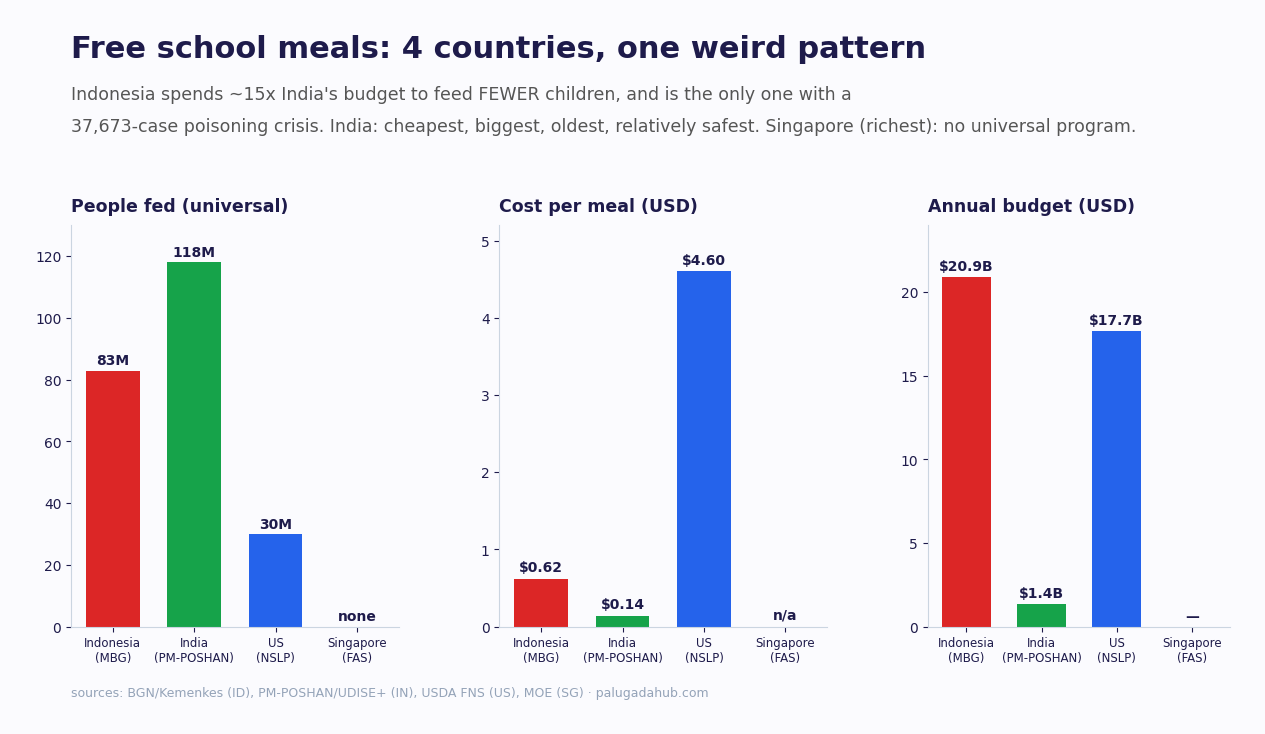
I started with one question about Indonesia's Makan Bergizi Gratis (MBG): is $0.62 a meal cheap? So I put it next to India, the US and Singapore. The comparison turned up something genuinely weird, money, scale and safety don't move together at all.
What
Four government meal programs, real numbers:
| Country | People fed | Cost/meal | Annual budget | Age |
|---|---|---|---|---|
| 🇮🇩 Indonesia (MBG) | 82.9M | $0.62 | ~$20.9B | 1 yr |
| 🇮🇳 India (PM-POSHAN) | 118M | $0.14 | ~$1.4B | ~24 yr |
| 🇺🇸 US (NSLP) | 29.9M | $4.60 | $17.7B | 80 yr |
| 🇸🇬 Singapore (FAS) | none (universal) | means-tested | n/a | n/a |
Why it matters
Here's the part that doesn't compute: Indonesia's budget ($20.9B) is roughly 15× India's ($1.4B), to feed fewer children (83M vs 118M). India runs the largest school-feeding program on earth on what Indonesia spends in under a month. And India's program, the cheapest and biggest and oldest, isn't the one in crisis. Indonesia's is, 37,673 suspected food-poisoning cases in roughly a year.
So the intuitive story ("you get what you pay for", "cheaper = more dangerous") is just wrong here. The cheapest, biggest program is the relatively safe one. The variable isn't money, it's maturity and operating model: India spent two decades refining decentralized, community-run kitchens; Indonesia stood up 21,000+ kitchens in months, most without hygiene certification.
Who it's for
Anyone who assumes a bigger budget buys a better program, policymakers, founders scaling anything fast, and Indonesians trying to understand why a well-funded flagship keeps making people sick.
When & where
All current (2025-26). The other quiet anomaly: Singapore, one of the richest countries on earth, has no universal free-meal program, only means-tested subsidies for low-income families. The wealth-to-universality relationship is inverted: the poorer countries (India, Indonesia) go universal and huge; the rich city-state targets only the needy.
How
Figures are public: Indonesia from BGN and Kemenkes (via Kompas/IDN Times); India from PM-POSHAN / UDISE+ 2024-25; US from USDA FNS; Singapore from MOE. The "cost per meal" lines aren't perfectly identical definitions (Indonesia's Rp10k production ceiling vs the US $4.60 federal reimbursement vs India's revised cooking cost), so read the orders of magnitude, not the decimals. Even allowing for that, the budget-vs-reach gap between Indonesia and India is too large to be a definitional artifact.
The takeaway
More money built Indonesia a bigger, faster program, not a safer one. India proves the binding constraint on feeding 100M+ children isn't budget. It's the boring, decades-long work of running kitchens that don't make anyone sick.
Data: BGN, Kemenkes, Kompas, IDN Times (ID); PM-POSHAN/UDISE+ (IN); USDA FNS (US); MOE (SG). 2025-26. Treat cost-per-meal as order-of-magnitude.
Building an AI agent?
I'm packaging how I ship them into one kit. Early access:
AI Agent Starter Kit →