I built a free agent that scores any site for AI search (ChatGPT, Claude, Perplexity)

People used to ask "how do I rank on Google?" Now they ask "why doesn't ChatGPT mention me?" Different game, different rules. So I built an agent to grade it.
Background, why I built this
I'd just made my own blog citable by AI search, robots that welcome AI crawlers, an llms.txt, FAQ schema, IndexNow. Doing it by hand, I realized every check was mechanical and repeatable. If I can score my own site, I can score any site. That's a tool, and a useful one, because GEO (Generative Engine Optimization) is where SEO was in 2004: everyone senses it matters, almost nobody has it set up.
What
GEO Audit, give it any URL and it returns a 0-100 score for how ready that page is to be cited inside AI answers, broken into seven checks, with the exact fixes ranked. Free, no keys.
Why it matters
AI search doesn't rank ten blue links, it reads a handful of sources and quotes them. If a bot can't crawl you, can't parse your structure, or you've no machine-readable map, you're simply not in the answer. GEO is the difference between being the source an AI quotes and being invisible. Most sites today score in the 30s without knowing it.
Who it's for
Founders, marketers, and devs who want their content surfaced by ChatGPT/Claude/Perplexity, and anyone curious whether their site is even readable by AI crawlers (most JS-heavy sites aren't).
When & where
Run it any time against any public URL. It checks the page and the domain root (robots, llms.txt, sitemap) in one pass.
How
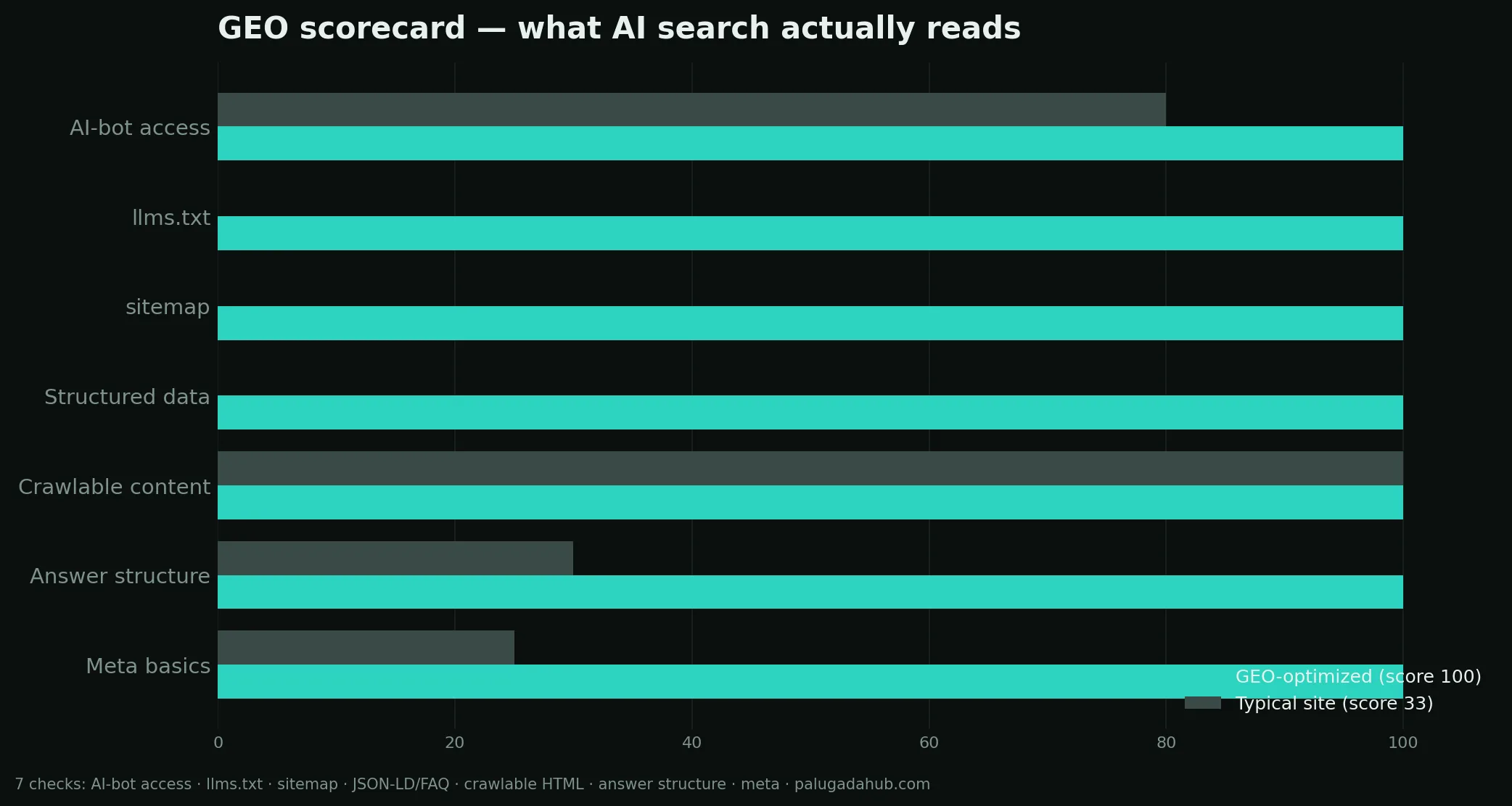
Seven weighted checks, all from the raw HTML + a few well-known files, no JS execution (because AI crawlers don't run JS either):
- AI-bot access, does
robots.txtwelcome GPTBot / ClaudeBot / OAI-SearchBot / PerplexityBot, or quietly block them? - llms.txt, the llmstxt.org map that tells LLMs what you're about.
- sitemap.xml, present and submittable.
- Structured data, JSON-LD (
Article/BlogPosting) and especiallyFAQPage, the schema AI answer engines quote most. - Crawlable content, is the actual text in the HTML, or hidden behind a JavaScript shell a bot can't render?
- Answer structure, clear Q&A headings (the 5W1H pattern) and visible dates.
- Meta basics, title, description, canonical, Open Graph.
Each check returns a score + a one-line fix; the agent weights them into a total and a band (Strong / Decent / Weak / Invisible). Watch it grade an optimized page (100) against a typical one (33):

Case study, auditing my actual competitors
A score in a vacuum means nothing. So I pointed the agent at five real sites in the same business model, developer starter kits / SaaS boilerplates, including my own agent-kit landing. This is who competes for the same AI "answer slot" when someone asks "best Next.js starter kit."
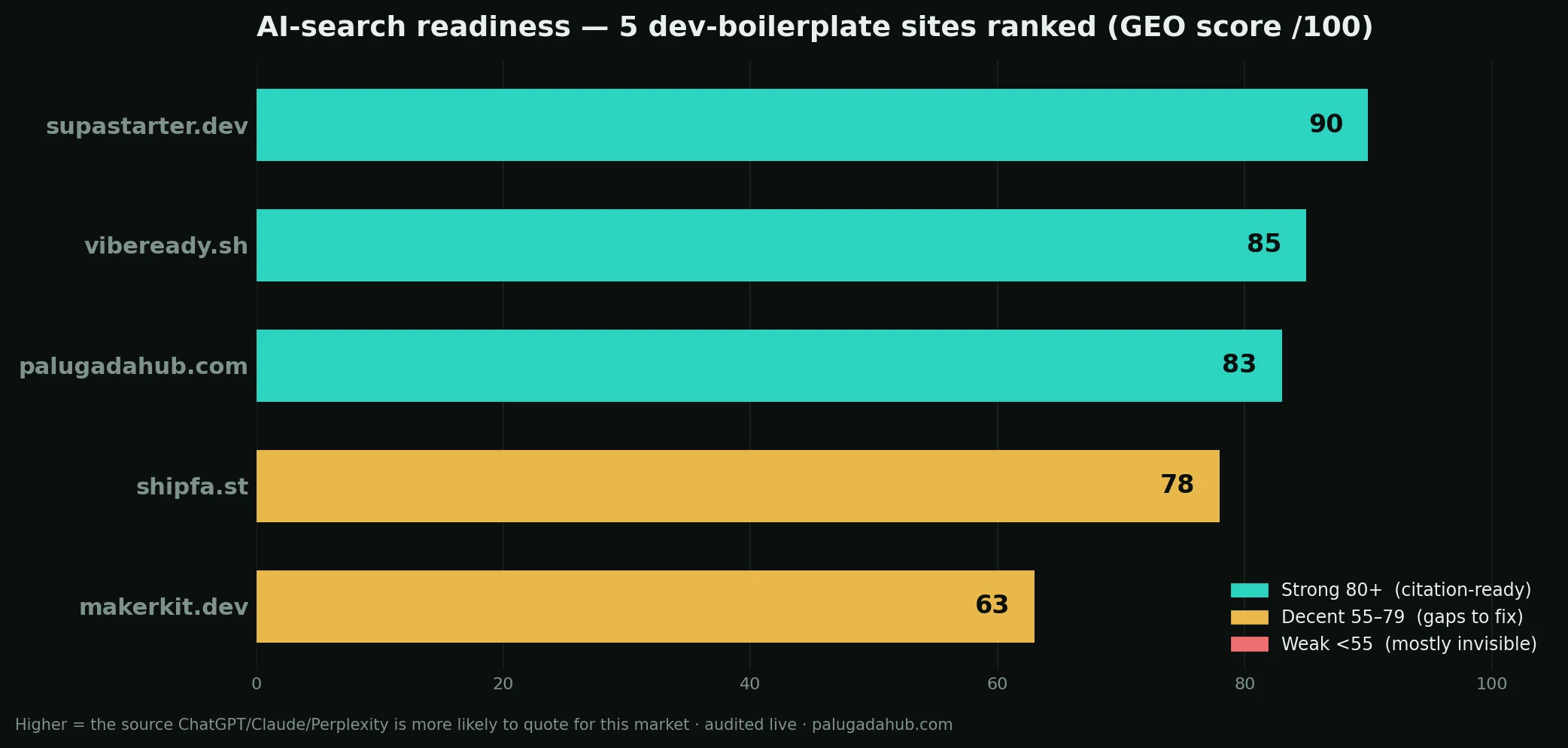
Then the per-check breakdown, where each one wins or leaks:
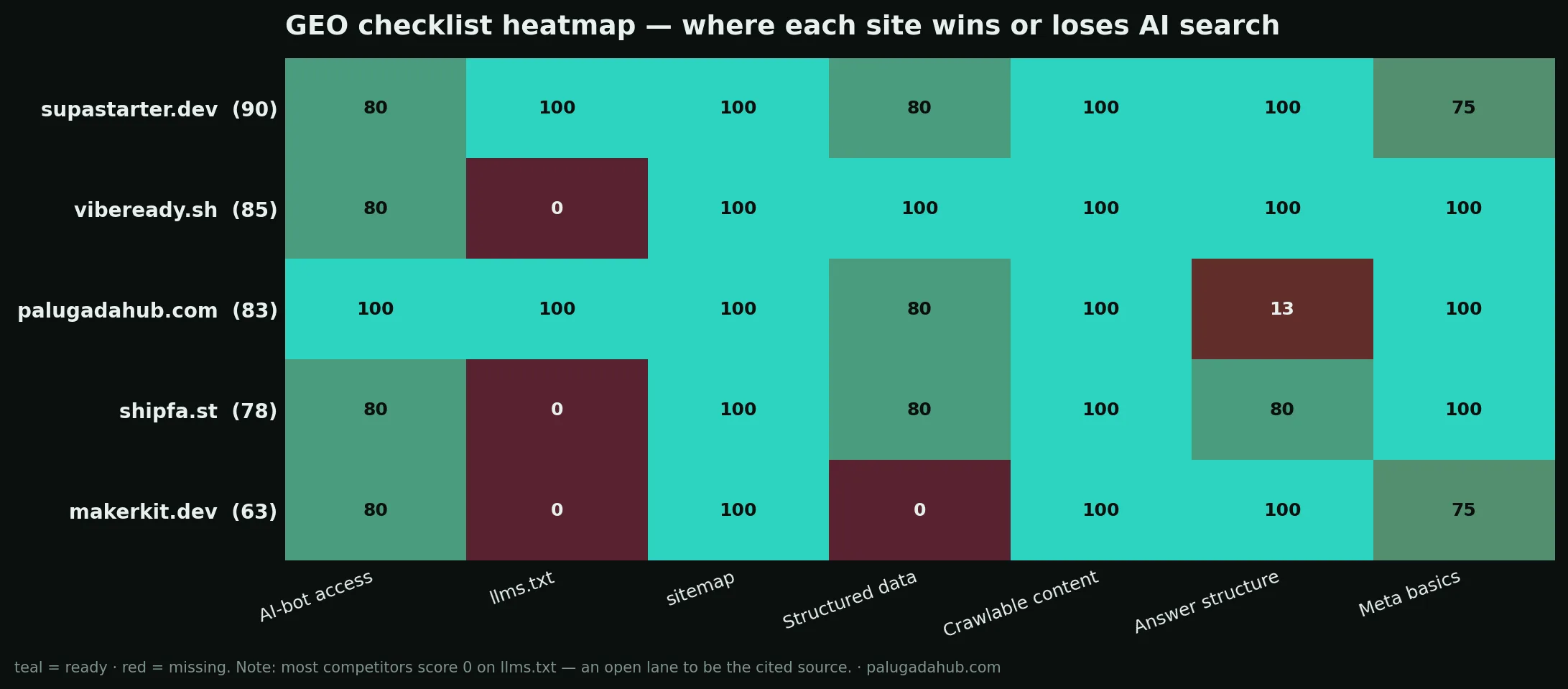
Three findings jump out:
- Even funded competitors leave the door open. Four of the five score 0 on
llms.txt, the one file that hands an LLM a clean map of the site. That's an open lane: the first to do it well becomes the easy source to cite. - One leader pulls ahead on fundamentals. The top site wins by doing the boring things, a map, structured Q&A, clean schema, not by spending more.
- My own weak spot is visible. The agent-kit landing scores high overall but 13 on answer-structure, it's a sales page, not a question-and-answer page. The fix is obvious: add an FAQ section. The audit found my own gap.
Does region, ads, or SEO change this?
Three questions everyone asks, answered straight:
- Region / language matters. AI search pulls different sources for an Indonesian prompt than an English one. A page that's perfectly optimized in English can be invisible to a Bahasa query. Localized content + local authority is its own GEO game.
- Ads do not buy citations. ChatGPT and Claude cite sources organically, there is no "sponsored citation." (Perplexity shows some ad units, but its quoted sources are organic too.) Ad budget moves clicks, not AI answers.
- SEO helps, but it isn't GEO. AI search leans on existing indexes (Bing feeds ChatGPT, Google feeds AI Overviews) plus their own crawlers, so basic SEO hygiene makes you findable. GEO is the layer on top, llms.txt, schema, answer structure, freshness, that decides whether you're quotable. Findable ≠ quotable.
How to actually stay on top
Once you're eligible, three levers keep you in the answer:
- Freshness, keep
dateModifiedcurrent; AI prefers recent sources. - Authority, be referenced elsewhere (the distribution lever). Citations beget citations.
- Be the clearest answer, to the exact question, in 5W1H + FAQ form. The answer slot is small; the cleanest source wins it.
The takeaway
SEO is about ranking. GEO is about being quotable. The mechanics, crawlable HTML, structured data, an llms.txt, an honest answer to a real question, are simple and almost nobody has them yet. That gap is the opportunity. Score your site, fix the reds, and become the source the model cites.
→ Run the free GEO audit on your own site, paste a URL, get the 0-100 score and the exact fixes in one pass. No sign-up.
Honest limits: a high GEO score makes you eligible to be cited, it doesn't guarantee citations (those depend on authority + relevance + the engines, and take weeks). This audits technical readiness, not your content's quality. Not an SEO guarantee.
Building an AI agent?
I'm packaging how I ship them into one kit. Early access:
AI Agent Starter Kit →