I built an agent that tells you which "BLT cair" is real, and which is a hoax

"Bantuan langsung tunai" trends almost every week in Indonesia. Around it sits a whole industry of clickbait sites promising "BLT Rp900.000 cair!", half of it stale, some of it phishing. So I built an agent to cut through it.
Background, why I built this
Every time bansos trends, the same thing happens: people search "BLT cair kapan", land on a sketchy site, and either get the wrong info or get asked to type their ID into a fake "cek penerima" form. The real information exists, it's just drowned out. A small agent that only trusts verified sources fixes that.
What
Bansos Radar, it answers three questions honestly: which cash-aid programs are actually active in 2026, how much and for whom, and which viral "cair" claims are hoaxes.
Why it matters
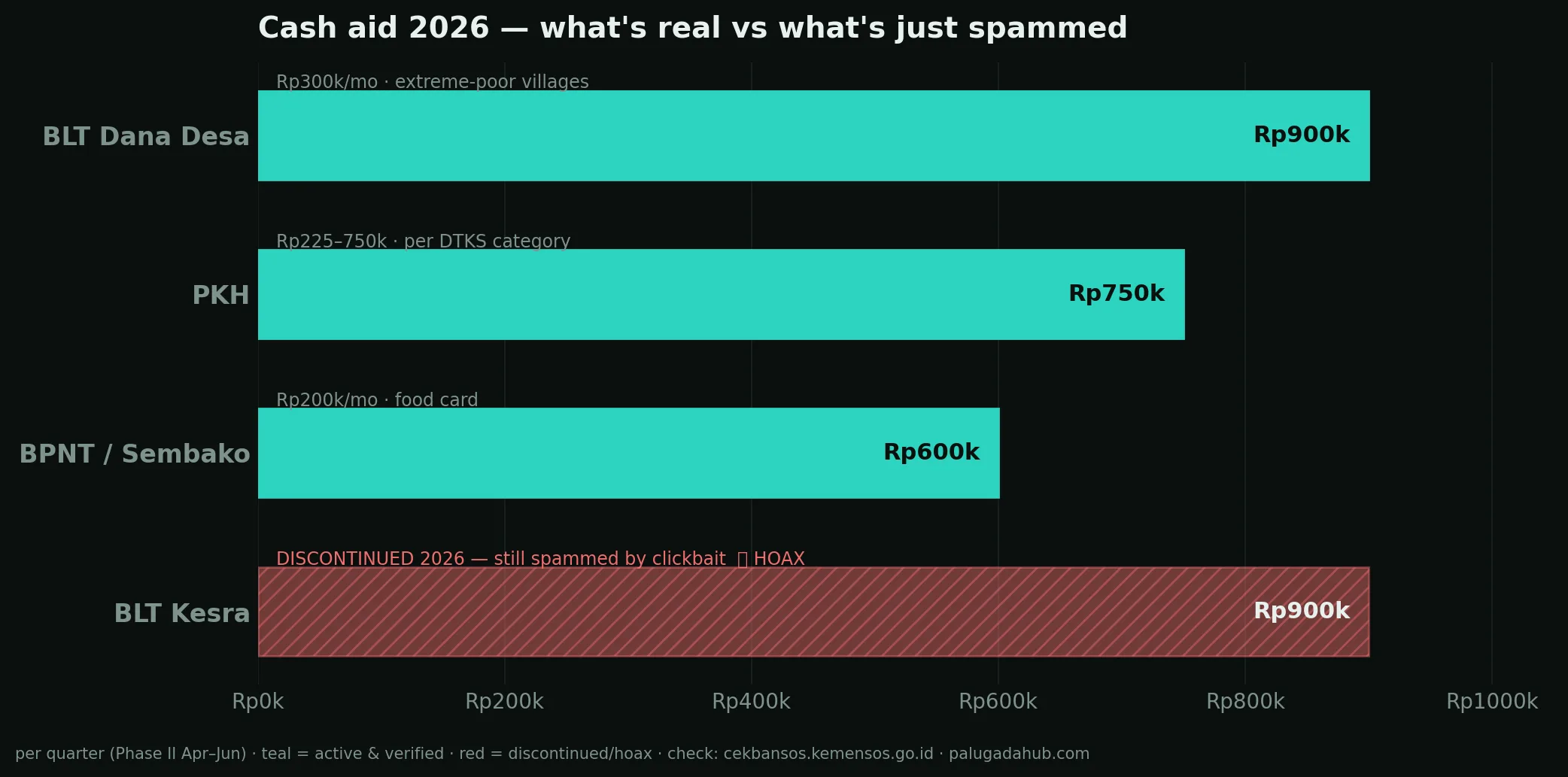
Misinformation here has a real cost, wasted hope, and phishing. The active programs (PKH, BPNT, BLT Dana Desa) are verifiable; the loudest claim of all, "BLT Kesra Rp900.000", was discontinued for 2026 (per Menko Airlangga), yet clickbait keeps reviving it. An agent that says "this one is real, that one isn't" is genuinely useful.
Who it's for
Anyone trying to figure out if they qualify and when money lands, and anyone tired of bansos clickbait. Also a clean template for a verification agent: trusted data in, hoax flags out.
When & where
It runs any time from the command line. The 2026 schedule it tracks is the Phase II window (Apr-Jun), the period that was actively trending.
How
Three commands, all grounded in verified data (Kompas, Bloomberg Technoz, Metro TV, Kemensos), clickbait bansos sites are explicitly not trusted:
list, active programs with amount, target group, and schedule.factcheck, scores viral claims against reality (BLT Kesra discontinued; "check via 3rd-party link" = phishing → only cekbansos.kemensos.go.id).check, a quick eligibility read by household category (heuristic; DTKS is the real gate).
Plus a trend overlay reading "BLT cair" search interest, so you can see the anticipation spike that the clickbait feeds on. Every action logs its reasoning.

The bigger shift, bansos is going biometric
Behind the weekly "BLT cair?" noise is a much larger move the government is pushing hard: tying aid to a digital, biometric identity. The 2026 plan stitches three systems together:
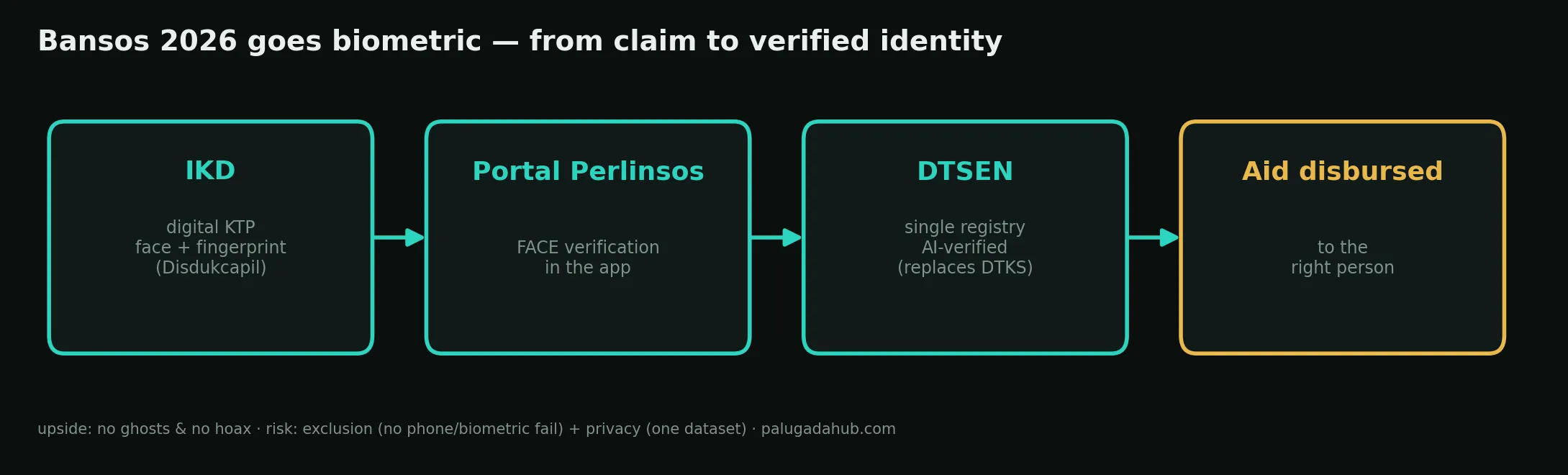
- IKD (Identitas Kependudukan Digital), a digital KTP you activate at Disdukcapil with a face + fingerprint scan.
- Portal Perlinsos, you verify with face recognition in the app; no queue, no photocopy.
- DTSEN, a single AI-verified social-economic registry replacing the old DTKS, deciding who's eligible.
Why the government wants it: kill ghost recipients and mis-targeting, one verified identity, money to the right person. And a bonus that fits this whole post: when there's one official channel (Perlinsos + IKD), the clickbait "cek penerima" sites and phishing forms lose their oxygen.
But the honest other side:
- Exclusion. Biometric gating can cut off exactly the people aid is for, no smartphone, far from a Disdukcapil office, elderly, a fingerprint that won't read. "Verified or no money" is dangerous when verification itself is the barrier.
- Privacy & concentration. Identity + biometrics + economic status + payments in one linked dataset is powerful, and a juicy target. Function-creep (used later for things it wasn't meant for) is the quiet risk.
- A single point of failure. One outage or data error, and aid stalls for people with no buffer.
That's the real debate under the trend: digital ID can make bansos cleaner and can exclude the vulnerable, both at once. An honest agent's job is to point you to the one real channel, flag the hoaxes, and not pretend the trade-off doesn't exist.
On target? What BPS data says
The whole point of biometric verification is accuracy, so the fair question is: was bansos hitting the right people in the first place? The data says not fully.
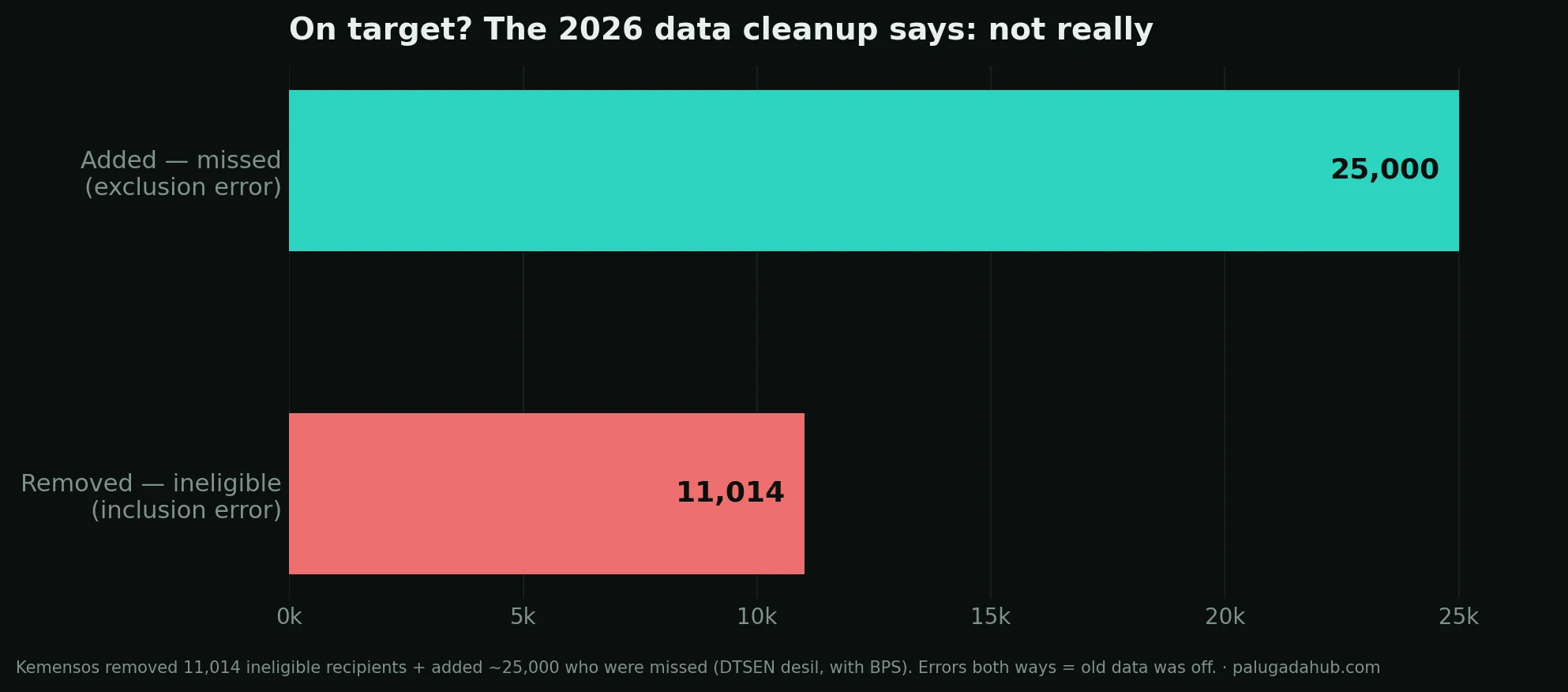
Targeting runs on a desil system (DTSEN, built with BPS): households are ranked into ten welfare groups, and aid targets Desil 1-4 (the bottom 40%). In the 2026 cleanup, Kemensos removed 11,014 recipients who didn't qualify (inclusion error, wrong people in) and added ~25,000 who'd been missed (exclusion error, right people out). Errors in both directions are the clearest proof the old data wasn't accurate.
And the yardstick itself is contested: academics argue BPS's 14 poverty indicators don't match real conditions, so the Desil 1-4 line mis-sorts people at the margin. Cleaner identity (IKD/biometric) fixes who is who, it does not fix what counts as poor. If the criteria are off, you just deliver the wrong target list more precisely.
That's the honest synthesis: biometric ID raises verification accuracy, but targeting accuracy depends on the poverty definition, and that's a BPS/policy question, not an identity one.
Who's actually covered (the agent does the math)
The agent crunches BPS + Kemensos numbers into the picture nobody draws:
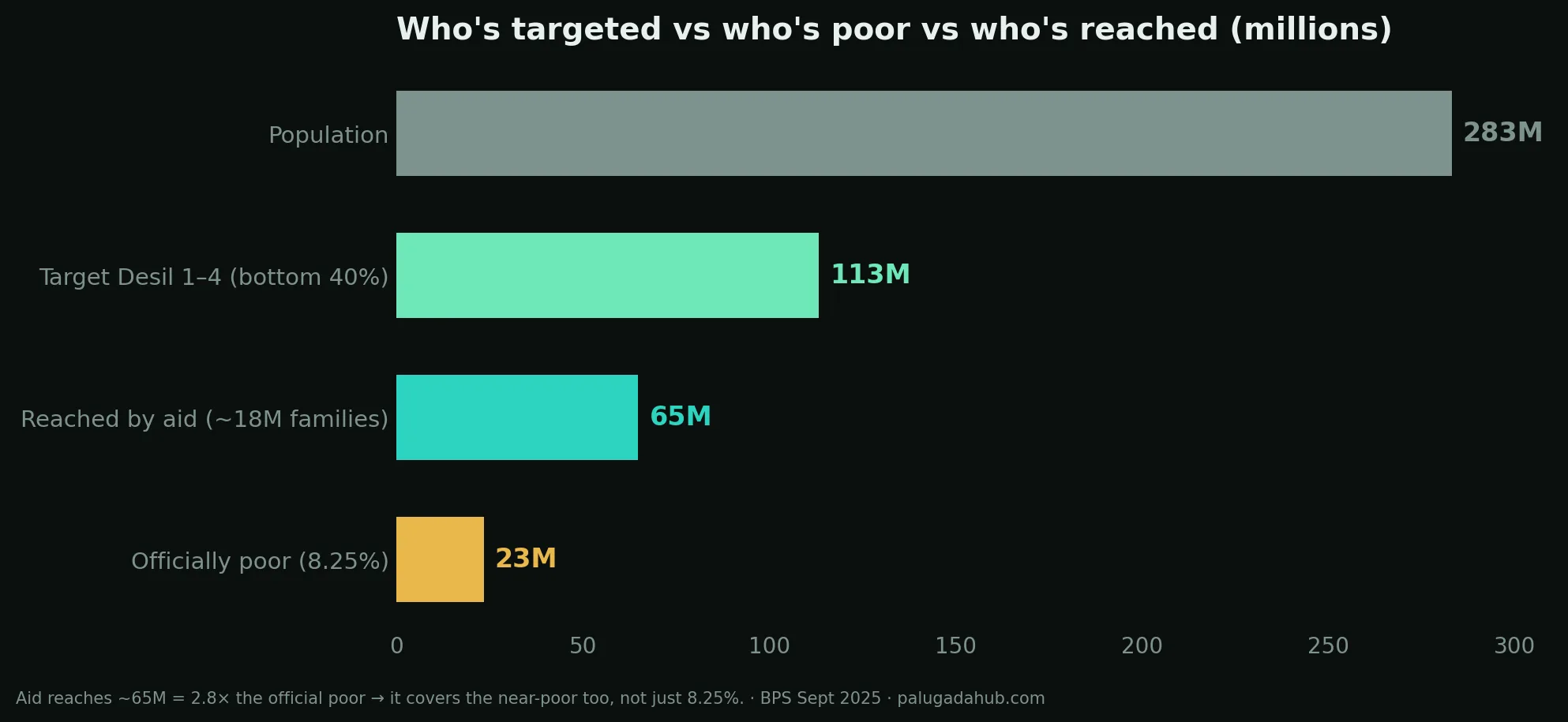
Of ~283M people, the bottom 40% (Desil 1-4 ≈ 113M) is the intended target. Bansos reaches roughly 65M (≈18M families × 3.6). But the officially poor are only 23.36M (8.25%). So aid reaches ~2.8× the official poor, by design it covers the near-poor/vulnerable too. That's the whole mis-targeting illusion: measure against 8.25% and it looks bloated; measure against the bottom-40% it's meant to protect and it's only ~57% covered.
Is it even enough?
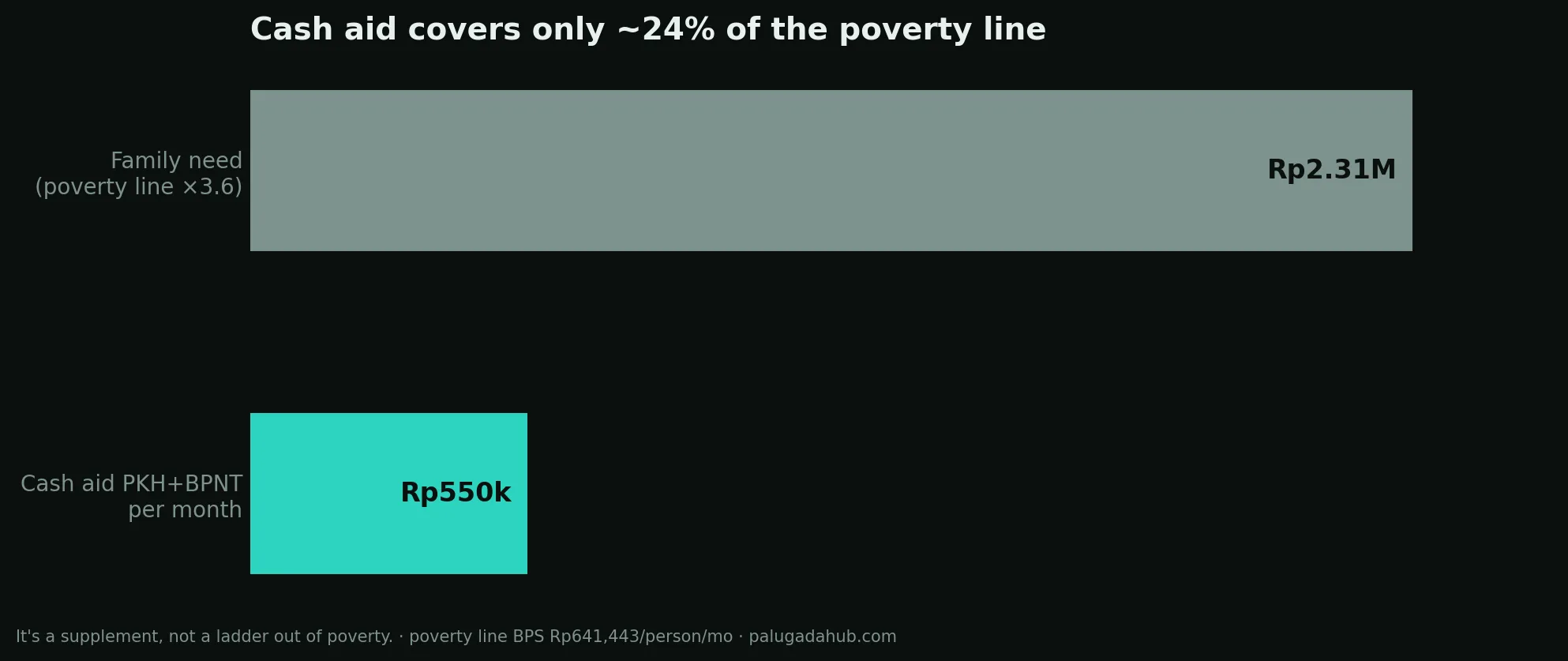
The poverty line is Rp641,443/person/month, about Rp2.31M/month for a family of 3.6. Stacked PKH + BPNT is roughly Rp550k/month. So aid covers only ~24% of what a poor family needs. It's a supplement, not a ladder out, useful context the next time someone says "they already got bansos, why are they still poor."
Fact-check scoreboard
The agent keeps a claims database and scores the viral ones, because the loudest "BLT cair" post is usually the least true:
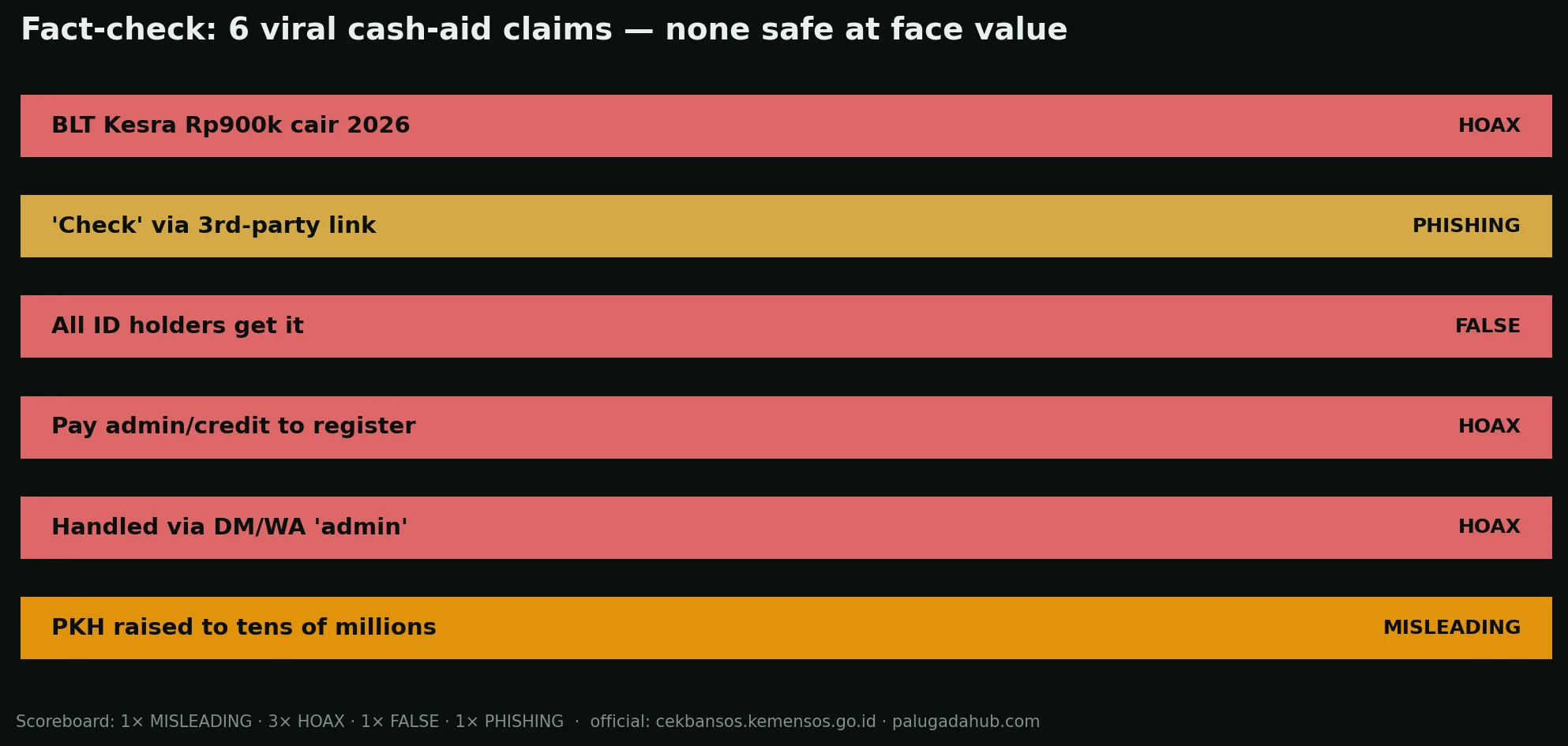
Six common claims, none safe to trust at face value: 3 outright hoax (discontinued Kesra, "bayar admin", "DM admin Kemensos"), 1 phishing warning, 1 false ("all KTP holders get it"), 1 misleading (inflated PKH amounts). The one rule that beats them all: cekbansos.kemensos.go.id, gratis, no admin, no pulsa.
The takeaway
The hard part of public data isn't finding it, it's filtering it. An agent that only trusts verified sources and names the hoaxes is a pattern you can point at vaccines, scams, elections, or any topic where the loudest claim isn't the true one.
Honest limits: amounts and schedules change, verify on the official cekbansos.kemensos.go.id before acting. Eligibility is decided by DTKS, not this heuristic. Not affiliated with any agency; this is an information tool, not an application channel.
Sources: Bloomberg Technoz, Metro TV. Digital ID / DTSEN: Bisnis.com. Targeting / BPS desil: Readers.id, InfoNasional.
Building an AI agent?
I'm packaging how I ship them into one kit. Early access:
AI Agent Starter Kit →