Social Media Regulation Posts Fixate on Conflict; the Network Boosts Criticism Instead
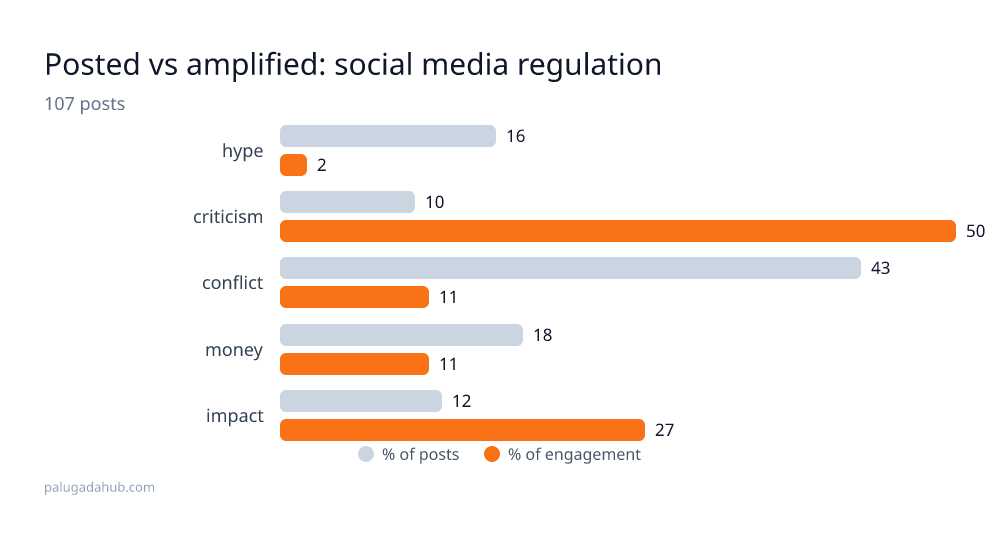
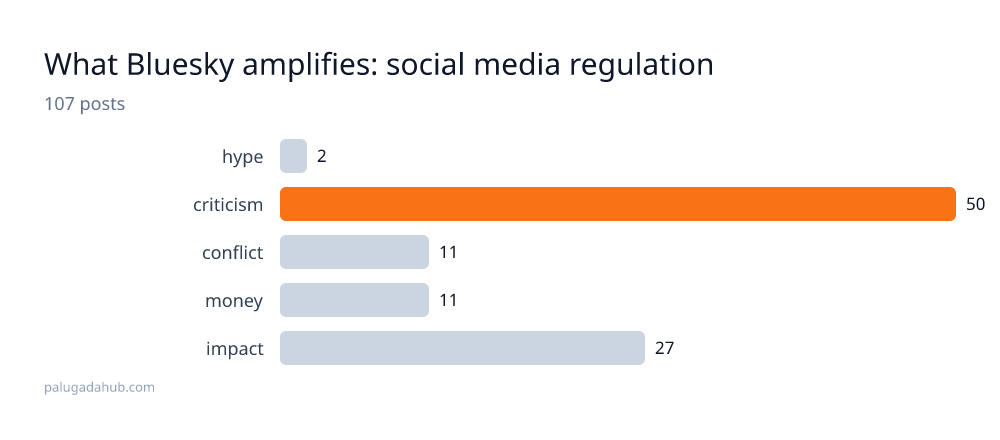
Conflict dominates the social media regulation conversation on Bluesky by post count, but criticism and backlash commands the engagement. Across 107 posts over 14 days, 43% of posts frame the issue as a power struggle or political conflict, yet that frame captures only 11% of total engagement. Criticism and backlash, by contrast, accounts for just 10% of posts but draws 50% of engagement, a five-fold amplification gap.
The inversion is sharp. Posts emphasizing human impact or business consequences trail both in volume and reach, together accounting for 30% of posts but only 38% of engagement. Hype and optimism barely register: 16% of posts, 2% of engagement.
| Frame | Posts (%) | Engagement (%) |
|---|---|---|
| Conflict / power | 43 | 11 |
| Criticism / backlash | 10 | 50 |
| Impact / human | 12 | 27 |
| Money / business | 18 | 11 |
| Hype / optimism | 16 | 2 |
The two most-engaged posts illustrate the pattern. An Irish Times story on AI-generated rage bait by Germany's far-right AfD drew 402 engagements, framing regulation as a response to a specific political threat. A Substack essay titled "How do you solve a problem like social media?" pulled 378 engagements by taking a critical, systemic view. Both lean on criticism or consequence, not conflict as a debate.
Why it matters
The gap suggests the network's amplification mechanism favors diagnosis over disputation. Posts that frame regulation as a partisan or institutional power play proliferate, but they do not travel far. Posts that step back and critique the problem itself, or warn of specific harms, get boosted. This may reflect Bluesky's user base: early-adopter professionals and journalists skeptical of social media's role, more likely to engage with substantive criticism than with political theater.
For regulators and platforms watching the conversation, the finding cuts both ways. The dominance of conflict framing in raw post volume suggests polarization in how users think about the issue. But the network's preference for criticism suggests a readiness to hear evidence-based arguments about harm and solution, if they are presented outside a partisan frame.
Who it's for
Policy makers and communications teams monitoring Bluesky as a signal of informed opinion. Journalists covering regulation. Platform researchers tracking how different frames compete for attention on decentralized networks.
When and where
Data spans 14 days of English-language posts tagged with "social media regulation" on Bluesky, collected via searchPosts. The sample includes 107 posts, of which 41 were classified by frame (conflict, criticism, impact, money, hype) using regex pattern matching on headlines and text. Engagement is the sum of likes, reposts, and replies.
How
The analysis uses descriptive statistics and frame-classification across the 41 posts with sufficient text for thematic coding. Engagement is weighted equally across reaction types (likes, reposts, replies treated as unit counts, not normalized by post age or follower count). The caveat: posts without clear news links or explicit framing language were excluded, which may bias the sample toward more structured, media-driven discourse and undercount informal takes on regulation.
The takeaway
On social platforms, the most-posted frame is not always the most-amplified one. Bluesky's users post conflict; they engage with criticism. The gap is a signal of what the network's audience values versus what it produces, and it suggests that platforms with smaller, more engaged communities may amplify substance over spectacle more reliably than algorithmic feeds tuned for outrage.
Building an AI agent?
I'm packaging how I ship them into one kit. Early access:
AI Agent Starter Kit →