Climate Policy Posts Lead With Money, But Conflict Wins the Engagement
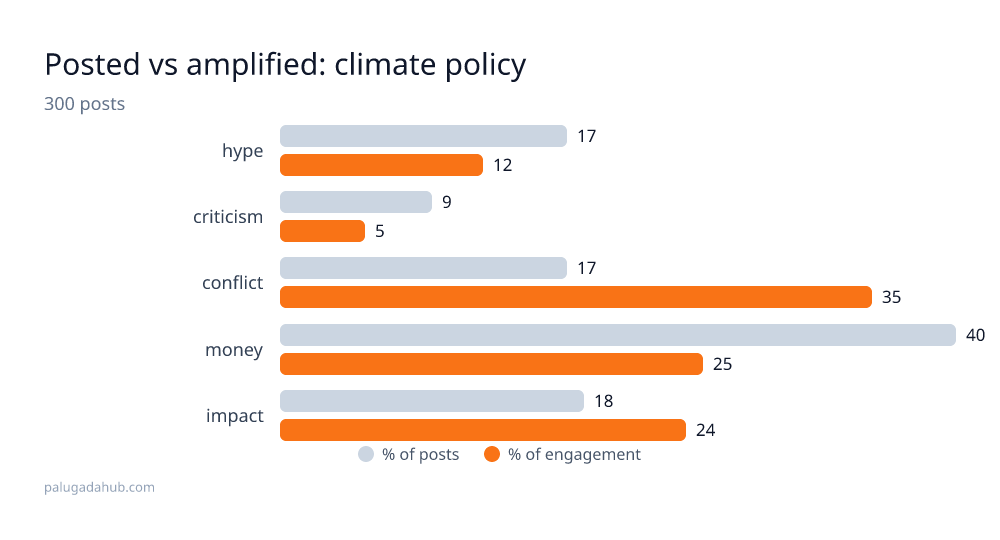
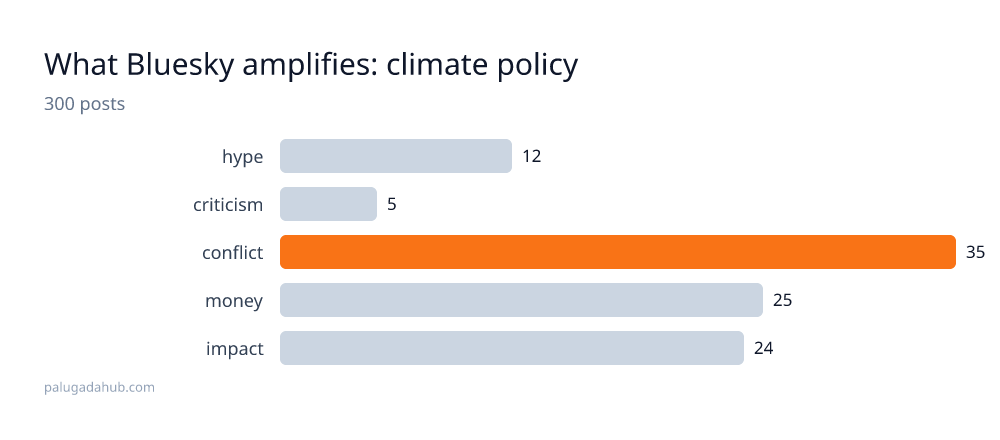
Money dominates what people post about climate policy on Bluesky, but conflict is what the network amplifies. Posts framed around business and financial stakes account for 40% of the 119 theme-classified posts, yet capture only 25% of total engagement. Conflict and power dynamics, by contrast, represent just 17% of posts but draw 35% of engagement, a gap of 18 percentage points that inverts the posted-to-amplified ratio.
The data come from 300 English-language posts on climate policy over 14 days, weighted by likes, reposts, and replies. Of those, 119 were classified into five frames: hype and optimism, criticism and backlash, conflict and power, money and business, and human impact. The engagement share by frame reveals a network that boosts confrontation over transaction.
| Frame | Posts (%) | Engagement (%) | Gap |
|---|---|---|---|
| Money / Business | 40 | 25 | -15 |
| Conflict / Power | 17 | 35 | +18 |
| Impact / Human | 18 | 24 | +6 |
| Hype / Optimism | 17 | 12 | -5 |
| Criticism / Backlash | 9 | 5 | -4 |
The single most-engaged link illustrates the pattern. A Media Matters article titled "Fox blames climate policy for Europe's climate-exacerbated heat deaths" accumulated 178 engagements, framing the issue as a political attack and a factual dispute, conflict, not commerce. A second Media Matters post on the same story drew 113 more engagements. By contrast, the most-shared business-focused link, a Corporate Knights piece on Canadian clean-energy preferences, garnered 98 engagements.
The Guardian and CrowdJustice together account for 13 of the 147 posts with news links, but the engagement spike clusters around outlets that traffic in political friction: Media Matters dominates the top-engagement list with two entries, while Nature's climate-attribution research, which frames the issue as predictive science, drew 60 engagements.
Why it matters
The gap between posted frames and amplified frames suggests that Bluesky's climate-policy conversation is shaped less by what users choose to share than by what the algorithm or the user base rewards. Posts about policy mechanisms, costs, and business cases are common, but they do not generate the velocity of engagement that confrontation does. This may reflect the platform's user base, which skews toward people who engage more readily with political and institutional critique than with technical or economic analysis. It may also reflect the nature of Bluesky's engagement mechanics: conflict, disagreement, and power-struggle narratives tend to generate replies and debate, while business-framed posts may attract fewer interactions even if they are posted more often.
For climate communicators and policy advocates, the finding suggests a mismatch between what they post and what gains traction. If the goal is reach, framing climate policy as a conflict between competing interests or institutions may outperform framing it as a business or market opportunity, even if the latter is more accurate or actionable.
Who it's for
Climate policy communicators, advocacy organizations, and researchers tracking how climate narratives spread on social platforms. Also relevant to platform researchers studying the relationship between posting behavior and algorithmic amplification.
When and where
Data span 14 days of Bluesky posts classified by theme and weighted by engagement (likes, reposts, replies). The 119 theme-classified posts represent 40% of the 300 total posts in the sample; 147 posts included a news link. The most-engaged links come from Media Matters, Corporate Knights, and Nature, suggesting a mix of political-commentary and research outlets.
How
The analysis used regex-based frame classification across headlines and post text to sort posts into five thematic buckets. Engagement was weighted equally across likes, reposts, and replies, then aggregated by frame to calculate the share of total engagement each frame received. The comparison between post share and engagement share reveals which frames are overposted relative to their engagement pull, and which are underposted relative to their amplification. The caveat: frame classification from headlines and text is coarse; a post may contain multiple frames, and the dominant frame may not be the one that drives engagement. Additionally, the 119 classified posts represent a subset of the 300 total, so the frame distribution may not hold across the full sample if unclassified posts skew differently.
The takeaway
On social platforms, what people post and what the network amplifies are often misaligned. The mismatch is not random; it reflects the incentive structure of engagement itself. Conflict generates interaction; transaction does not. For climate policy to gain traction on Bluesky, advocates may need to reframe the issue not as a business problem but as a power struggle, even if the underlying policy is fundamentally economic. The question for communicators is whether that reframing serves the goal of policy change or distorts it.
Building an AI agent?
I'm packaging how I ship them into one kit. Early access:
AI Agent Starter Kit →