Bluesky Posts Food-Price Criticism Seven Times, Amplifies It Once
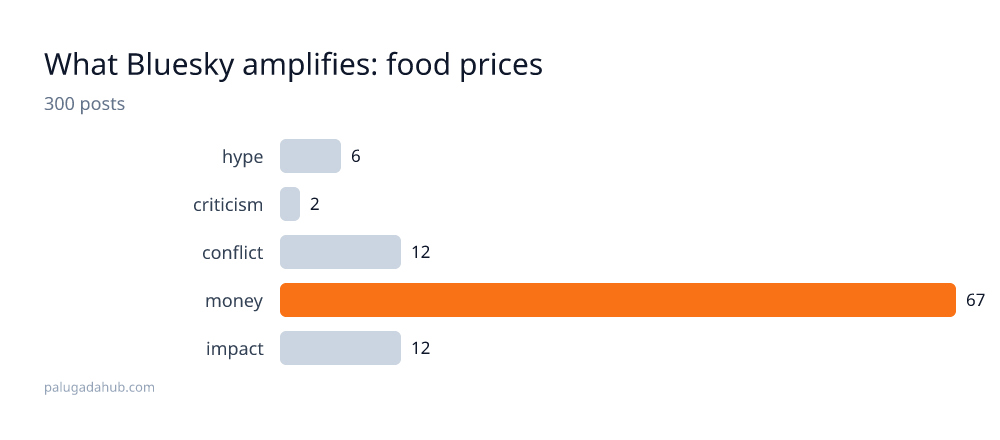
Bluesky users posted criticism of food-price policies and corporate behavior seven times over the past two weeks. The network amplified it once.
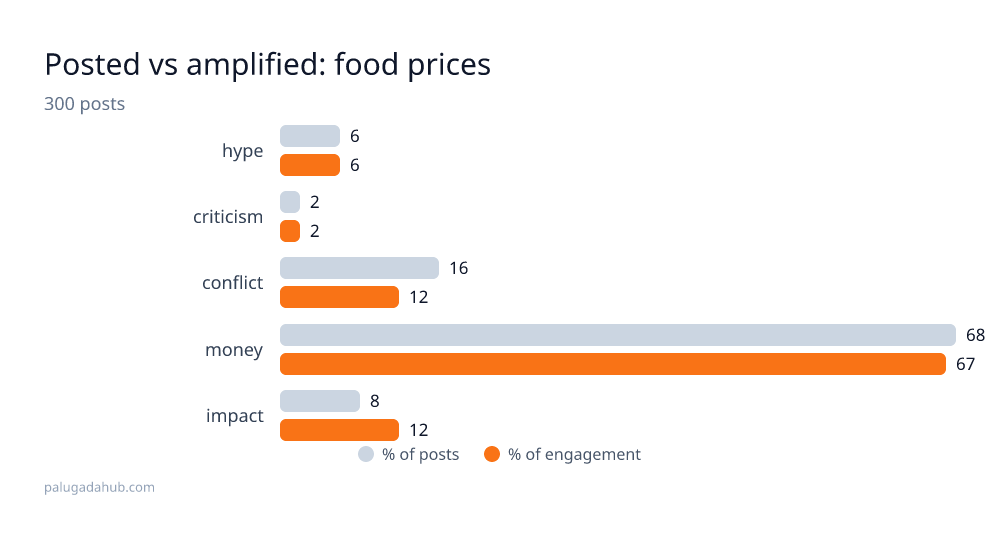
Across 300 posts classified by frame, criticism and backlash accounted for just 2% of total engagement (likes, reposts, replies), despite representing 2% of posts by count. By contrast, money and business frames drew 67% of engagement from 68% of posts. The silence around criticism is not accidental; it is structural. Users generate the frame at roughly the rate the network would expect, but the network declines to boost it.
| Frame | Posts | Post Share | Engagement Share |
|---|---|---|---|
| Money / Business | 257 | 68% | 67% |
| Conflict / Power | 59 | 16% | 12% |
| Impact / Human | 31 | 8% | 12% |
| Hype / Optimism | 23 | 6% | 6% |
| Criticism / Backlash | 7 | 2% | 2% |
The top-amplified stories tell the story: a Canadian government plan to boost food access (35 engagements), a political clash over Walmart price claims (17 and 16 engagements each), and a supply-chain oddity about anchovies and salmon (14 engagements). None of these are critiques of the food system itself. The most shared domains were YouTube (18 posts total), HuffPost (6), and CBC News (3), none of which dominated the criticism frame.
Why it matters
Food-price criticism on social media typically surfaces structural failures: corporate pricing power, policy gaps, or wage stagnation. When the network posts it but does not amplify it, the frame exists as a minority view, visible only to those who search for it. The majority of users see business analysis, supply-chain stories, and political theater instead. This is not censorship; it is preference. Bluesky's algorithm, or the users who compose it, treats criticism as less worth repeating than explanation or conflict.
The mechanism is engagement-weighted amplification. Posts that draw fewer likes, reposts, and replies rise less often in feeds and search results. Criticism posts, by this measure, do not compel the network to engage. Whether that reflects genuine disinterest or a structural bias toward business framing is a separate question; the data show only the outcome.
Who it's for
Policymakers and journalists tracking how food-price discourse moves on social platforms. Researchers studying frame dominance in decentralized networks. Advocates trying to understand why criticism of corporate pricing or policy often fails to gain traction on Bluesky, even when posted.
When and where
Data drawn from 300 English posts on "food prices" across Bluesky over 14 days, classified by frame using regex pattern matching on headlines and post text. Engagement weighted by the sum of likes, reposts, and replies. The sample includes posts with and without news links; 95 posts (32%) carried external links to news sites.
How
We classified posts into five frames (money/business, conflict/power, impact/human, hype/optimism, criticism/backlash) using keyword and phrase matching against headlines and post text. Engagement was summed across all interactions and allocated to each frame as a share of total engagement. We then compared post share (what users posted) to engagement share (what the network amplified) to identify frames that underperformed their posting rate. Criticism emerged as the clearest gap: 2% of posts, 2% of engagement, but only seven posts total, making it a small sample. The finding holds within this data but may not generalize to longer time windows or other topics.
The takeaway
On Bluesky, the loudest frame is not always the most posted frame. Business and market angles dominate both posting and amplification, creating a self-reinforcing loop. Criticism, by contrast, is posted but not repeated, suggesting it either fails to resonate with users or lacks the structural incentive to spread. In decentralized networks, silence is not the absence of speech; it is the absence of reach.
Building an AI agent?
I'm packaging how I ship them into one kit. Early access:
AI Agent Starter Kit →