Money Dominates AGI Posts, but Criticism Wins the Engagement
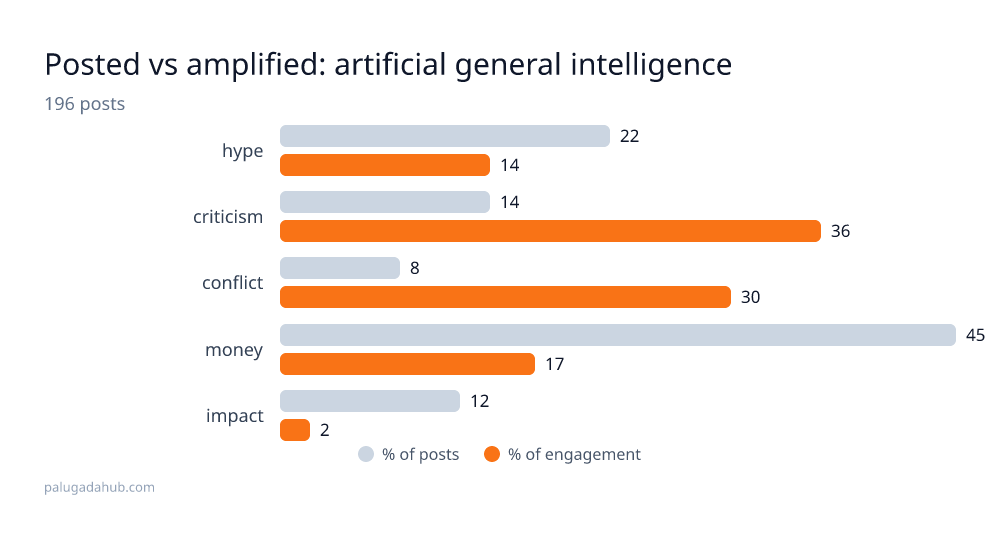
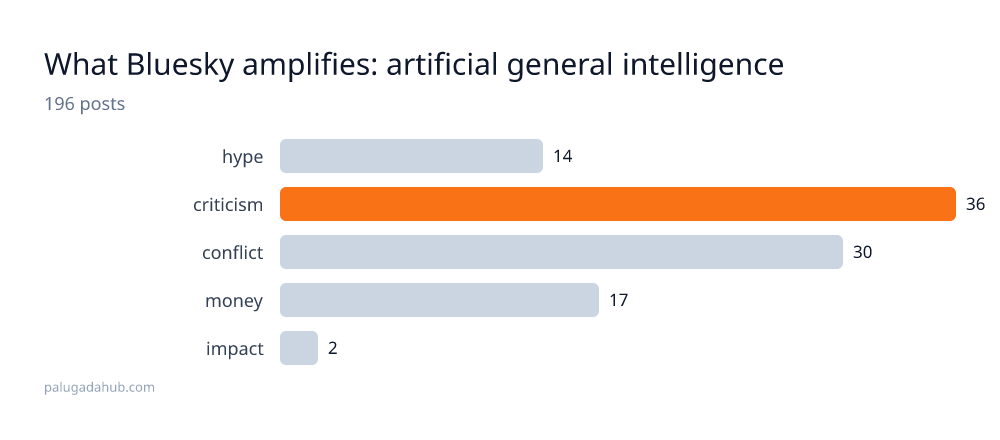
Nearly half the posts about artificial general intelligence on Bluesky focus on money and business, yet the network's engagement engine amplifies criticism at more than double that rate. Business frames account for 45% of posts by count but only 17% of total engagement, while criticism and backlash represent just 14% of posts yet capture 36% of engagement across the 196 posts analyzed over 14 days.
The inversion is sharp. Posts about funding, valuations, executive moves, and market dynamics dominate the feed, but they do not move the network. Skeptical takes, warnings, and pushback do. The gap suggests that Bluesky's AGI conversation, despite its surface focus on capital and corporate news, runs on doubt.
| Frame | Posts (%) | Engagement (%) | Ratio |
|---|---|---|---|
| Money / Business | 45 | 17 | 0.38 |
| Criticism / Backlash | 14 | 36 | 2.57 |
| Conflict / Power | 8 | 30 | 3.75 |
| Hype / Optimism | 22 | 14 | 0.64 |
| Impact / Human | 12 | 2 | 0.17 |
The single most-engaged link underscores the pattern: a Wall Street Journal exclusive on OpenAI executive Fidji Simo stepping down drew 48 engagements, more than six times the second-place academic paper on AI-generated text detection (7 engagements). Corporate drama wins. But the broader distribution shows that when users engage with AGI content, they gravitate toward frames that question, contest, or expose power dynamics. Conflict and power framing, which represents only 8% of posts, captures 30% of engagement.
This is not a simple "users want bad news" effect. Impact and human-centered frames, which might be expected to carry emotional weight, barely register at 2% of engagement despite 12% of posts. The network is not amplifying emotional or humanitarian concerns; it is amplifying intellectual challenge and institutional skepticism.
Why it matters
The gap reveals a structural mismatch between what the network's most active posters believe the audience wants (business news, funding announcements, optimistic takes) and what the network's engagement actually rewards (criticism, power analysis, conflict). This creates a feedback loop: business-focused posts will continue to dominate the feed because they are easier to produce and share, but they will remain underamplified. Skeptical and analytical takes, though rarer, will punch above their post weight.
For journalists and researchers covering AGI, this suggests that Bluesky's audience is primed to engage with critical framing and institutional analysis. Posts that lead with funding or hype will underperform relative to posts that interrogate claims, expose contradictions, or map power structures. The platform is not optimizing for the business narrative; it is optimizing for the critical one.
Who it's for
Editors and reporters covering AI and tech policy will want to note that Bluesky engagement patterns differ sharply from mainstream tech media, which leads heavily on funding and executive moves. Researchers studying how social networks amplify or suppress certain frames in emerging technology debates will find a clear case study here: the gap between what is posted and what is amplified can be substantial, and it favors skepticism over hype.
When and where
This analysis covers 196 English-language posts tagged with "artificial general intelligence" on Bluesky over 14 days, weighted by engagement (likes, reposts, and replies combined). The most-shared domains include europesays.com and siliconangle.com (6 posts each), alongside traditional outlets like Reuters and The Verge. The Wall Street Journal link, though shared only once, generated the highest engagement.
How
Posts were classified by frame using regex pattern matching and manual review of headlines and text against five categories: hype/optimism, criticism/backlash, conflict/power, money/business, and impact/human. Engagement was summed across all interactions (likes, reposts, replies) and divided by frame to calculate share of total engagement. The ratio of engagement share to post share was computed to surface frames that are underposted but overamplified. This is a descriptive comparison; it does not account for differences in post timing, account authority, or network effects. The sample size for frame classification is 47 posts with sufficient text; the remaining 149 posts were counted by engagement but not classified by frame, which may bias the distribution if unclassified posts cluster in particular frames.
The takeaway
On social networks, the most-posted frame is not the most-amplified frame, and the gap can be wide. When the gap favors skepticism over optimism or power analysis over business news, it signals that the network's active users are filtering for intellectual rigor or institutional critique, not surface-level news. This pattern may persist or reverse as the network's user base changes, but in this moment, Bluesky's AGI conversation runs on doubt, not on capital.
Building an AI agent?
I'm packaging how I ship them into one kit. Early access:
AI Agent Starter Kit →