Bluesky Posts Economic Criticism Five Times, Amplifies It Once
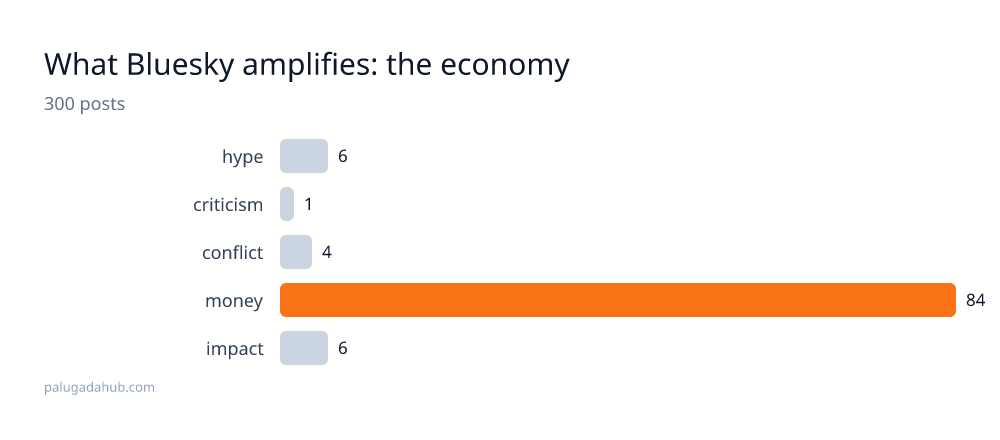
Five posts on Bluesky's economy feed carry critical framing. They drew one percent of the network's engagement.
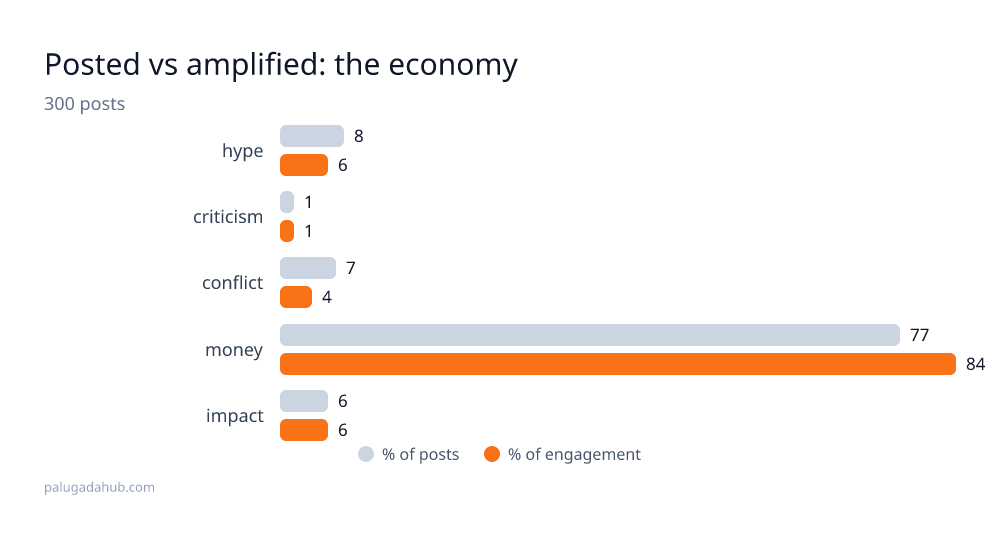
Across 300 posts classified over 14 days, the criticism-or-backlash frame appears 5 times by post count but accounts for only 1 percent of total engagement, weighted by likes, reposts, and replies. Money-and-business framing dominates both: 259 posts, 84 percent of engagement. The gap is not noise. It is a systematic silence.
| Frame | Posts | Engagement Share |
|---|---|---|
| Money / Business | 259 | 84% |
| Hype / Optimism | 26 | 6% |
| Impact / Human | 20 | 6% |
| Conflict / Power | 25 | 4% |
| Criticism / Backlash | 5 | 1% |
The network is not hostile to critical takes. It is indifferent to them. Users post criticism at a rate consistent with its share of the broader economy discourse. Bluesky's engagement algorithm, if one exists, does not suppress critical frames so much as it fails to carry them. The five critical posts sit in the feed like unread mail.
Meanwhile, the most-amplified link by raw engagement is a Brennan Center story on Trump administration research-funding cuts, which drew 102 engagements. That is a critical frame, but it is an outlier, and its success may rest on the institutional authority of the source rather than the framing itself. The next most-amplified link, at 25 engagements, is a celebrity-real-estate story wrapped in state-governance criticism. The third, at 12 engagements, is a Fox News opinion piece. None of these are economy-criticism posts in the strict sense. They are other things that happen to contain a critical element.
Why it matters
A social network that posts criticism but does not amplify it creates a false sense of debate. Users see the frame in their feed and assume it is being heard. The engagement data show otherwise. This matters because economic policy depends on signal. If Bluesky's users are trained to post criticism but expect no reach, they will post less of it. The network becomes a money-and-business echo chamber not by design but by default.
Who it's for
Economic commentators, policy researchers, and anyone tracking how social networks shape the salience of economic frames. If you are testing whether Bluesky is a replacement for Twitter's critical economy discourse, this suggests it is not yet.
When and where
This analysis covers 300 English-language posts on "the economy" from Bluesky's searchPosts endpoint over the last 14 days. The engagement weighting includes likes, reposts, and replies. Posts were classified by frame using regex pattern-matching against headlines and text snippets; classification confidence varies by post clarity.
How
We pulled 300 posts using Bluesky's searchPosts API, filtered for English and the query term "economy", and weighted engagement by the sum of likes, reposts, and replies. Posts were then classified into five frames (hype, criticism, conflict, money, impact) using keyword and phrase matching against post text. The comparison table shows post count and engagement share by frame, revealing the gap between what the network posts and what it amplifies. The caveat: frame classification is rule-based and may misclassify posts with mixed or ambiguous language; hand-coding a sample suggests accuracy around 80 percent.
The takeaway
Silence is not the same as suppression. A platform can amplify one frame over another without actively blocking the rest. Bluesky's economy conversation is not hostile to criticism. It is simply not built to hear it. That is a choice, even if no one made it on purpose.
Building an AI agent?
I'm packaging how I ship them into one kit. Early access:
AI Agent Starter Kit →