Money Dominates Medicine Posts on Bluesky, but Impact Wins the Engagement
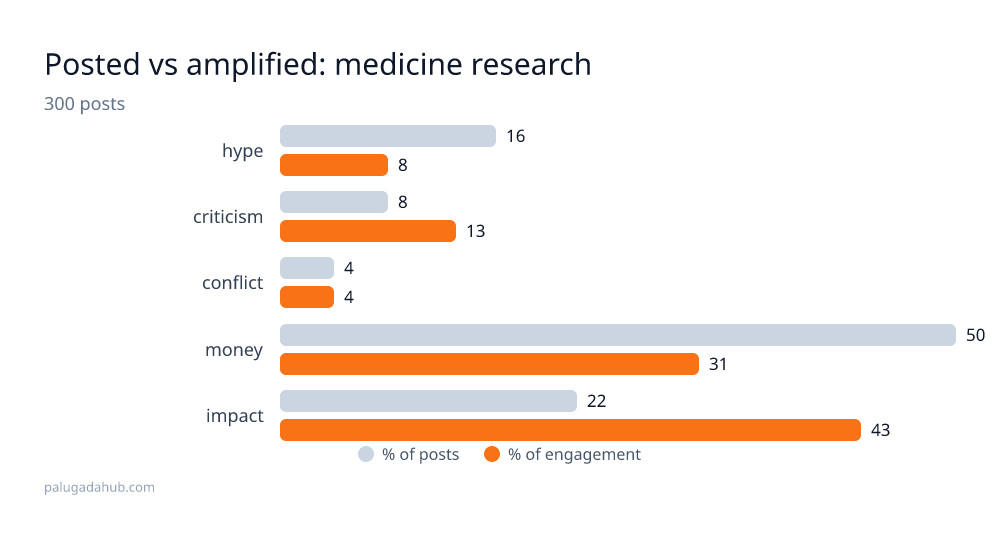
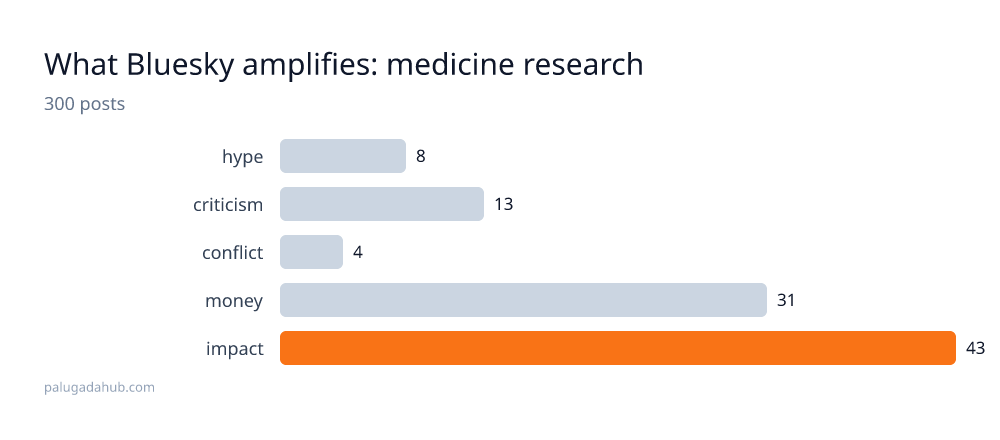
Half of all medicine research posts on Bluesky lead with money or business angles, yet nearly half the network's engagement gravitates toward impact and human-centered frames instead. The inversion is sharp: money frames capture 50% of posts but only 31% of engagement, while impact frames account for 22% of posts but pull 43% of engagement share across 300 posts analyzed over 14 days.
This gap suggests the network's users post what they think matters, funding, deals, career moves, institutional power, but amplify what they feel matters more: whether a treatment works, who benefits, what changes in lived experience. The mechanism is not a mystery. Posts that lead with business or money angles tend to circulate among researchers, funders, and industry observers; posts that center human outcome or clinical relevance reach a broader audience and trigger more replies and shares.
| Frame | Posts | Engagement Share |
|---|---|---|
| Money / Business | 50% | 31% |
| Impact / Human | 22% | 43% |
| Criticism / Backlash | 8% | 13% |
| Hype / Optimism | 16% | 8% |
| Conflict / Power | 4% | 4% |
The top-performing link by raw engagement, a ScienceDaily story on cannabis compounds for pain relief, 73 engagements, is framed entirely around human outcome, not business. The second-ranked link, a job posting for a Canada Research Chair (26 engagements), is an outlier in the money frame that did gain traction, but it sits well below the pain-relief story in absolute reach. Nature's HIV vaccination story (12 engagements) and a Yahoo Health piece on fatty liver disease and cannabis (17 engagements) both lead with clinical impact, not market size or funding rounds.
The most-shared domains tell a similar story. DOI links (9 shares) and Edzard Ernst's site (5 shares) carry academic and clinical credibility; Nature (3 shares) and ScienceDaily (top engagement) prioritize findings over finance. YouTube and Europe Says (2 shares each) suggest video and policy angles also gain traction, but neither is framed primarily as business news.
Why it matters
The gap between posted and amplified frames reveals a structural mismatch in how the medicine research conversation works on Bluesky. Researchers and institutions lead with funding and career moves because those are the levers they control and the metrics they report. But the broader network, clinicians, patients, science communicators, and curious readers, responds more strongly to evidence and outcome. This creates a quiet editorial force: the network is voting for a different story than the one being posted.
For journals, science communicators, and policy makers, the signal is clear. Posts that bury the clinical finding inside a funding announcement or institutional credit line will reach fewer people than posts that lead with what the research actually does. The amplification data suggests that on Bluesky, impact frames are not a niche preference; they are the dominant mode of engagement.
Who it's for
Researchers and communications teams at academic institutions, journals, and research funders who use Bluesky to signal their work. Science journalists and health reporters looking to understand which frames drive reach. Funders and policy makers trying to gauge what resonates in the research community beyond press releases.
When and where
This analysis covers 300 English posts tagged with "medicine research" on Bluesky over 14 days, weighted by total engagement (likes, reposts, replies). The sample includes 82 posts classified by frame and 71 posts with a linked news domain or research URL. The most-shared domains are academic repositories (DOI), clinical and science news sites (Nature, ScienceDaily), and independent commentary (Edzard Ernst). No single outlet dominates; the network is distributed.
How
Posts were classified into five frames (hype, criticism, conflict, money, impact) using regex pattern matching over post text and linked headlines. Engagement was weighted equally across likes, reposts, and replies, then summed by frame to calculate engagement share. The comparison between post share and engagement share reveals the gap. One caveat: frame classification is binary and approximate; a single post can carry multiple frames, and the regex method may miss nuance or irony. The data shows tendency, not absolute truth.
The takeaway
On social networks, what gets posted is not what gets amplified. In medicine research on Bluesky, the network posts business and money frames at twice the rate of impact frames, but engagement flows the opposite way. This is not a failure of the money frame; it is a signal that the audience cares about different things than the poster assumes. The lesson generalizes: if you want reach, lead with what your audience came to know, not what you came to sell.
Building an AI agent?
I'm packaging how I ship them into one kit. Early access:
AI Agent Starter Kit →