Bhnet.org Dominates Mental Health Links on Bluesky, Signaling a Fragmented News Diet
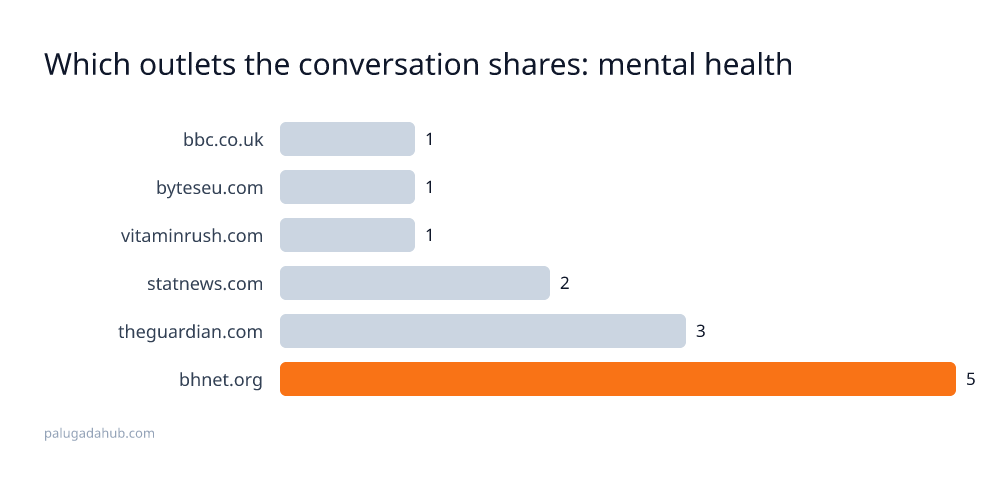
Bhnet.org appears in five of the 24 news links shared in Bluesky's mental health conversation over the past two weeks, more than double the reach of any other single outlet. The Guardian follows with three links, Stat News with two, and a long tail of one-off domains (Kiro7, Bytes EU, BBC, VitaminRush) filling the remainder. This concentration matters because it narrows the frame through which the network encounters mental health as a news story.
The engagement data reveal a deeper pattern. While 195 posts touched mental health over 14 days, only 24 included a news link, and those 24 posts generated 2,825 total engagements. The top two individual stories by engagement, a Kiro7 report on a 19-year-old shot during a mental health crisis and a Stat News piece on content creation's mental health toll, each drew 10 engagements. Yet bhnet.org's dominance in link-sharing does not translate to outsized individual story performance. Its five appearances suggest consistent citation rather than viral amplification of a single narrative.
| Outlet | Link Count | Share of Links |
|---|---|---|
| bhnet.org | 5 | 21% |
| The Guardian | 3 | 13% |
| Stat News | 2 | 8% |
| Other (5 outlets) | 9 | 38% |
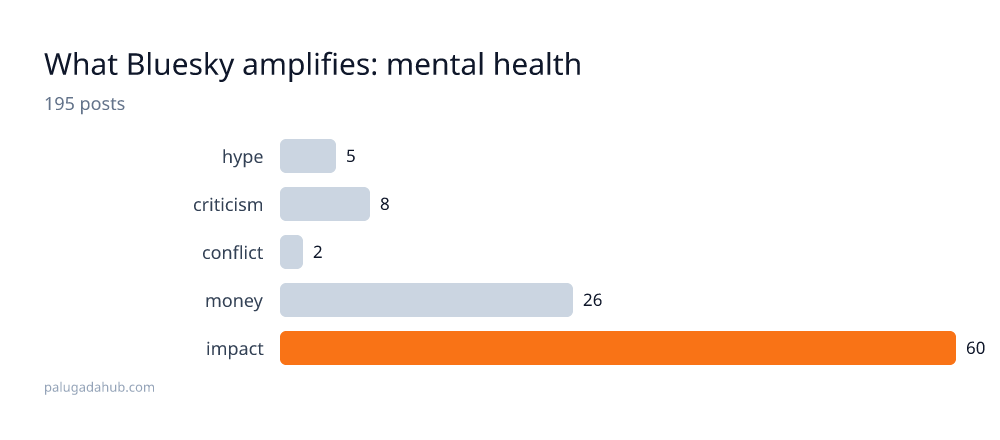
The framing split illuminates what bhnet.org and its peers are covering. Sixty percent of engagement goes to impact/human stories, while 26% flows to money/business frames. By post count, the ratio is similar: 59% impact/human, 16% money/business. This alignment between posted and amplified frames suggests the network is not suppressing any particular angle, but rather that mental health discourse on Bluesky orbits around lived experience and policy consequence, not market or pharmaceutical narratives. Bhnet.org's five appearances likely reflect its editorial focus on health equity and public health reporting, a niche that resonates with the network's dominant frame.
Why it matters
A news diet concentrated among a few outlets creates a structural vulnerability. If bhnet.org, The Guardian, and Stat News set the terms of the mental health conversation on Bluesky, readers encounter mental health through their editorial priorities and sourcing habits, not through a market of competing frames. This is not inherently bad, all three outlets employ rigorous reporting, but it means Bluesky's mental health discourse lacks the friction that comes from genuinely competing news organizations. The network amplifies what it posts, which suggests no algorithmic suppression, but the scarcity of links overall (24 out of 195 posts) indicates that most mental health talk on Bluesky is commentary, anecdote, or repost, not original reporting.
Who it's for
Mental health researchers and policy advocates who monitor Bluesky for signal on public concern should note that the conversation is mediated by a small editorial cohort. Journalists covering mental health can use this data to identify which outlets are shaping the narrative on the network. Media strategists at health nonprofits may find that bhnet.org's dominance reflects an audience already primed for equity-focused reporting.
When and where
This analysis spans 14 days of English-language posts on Bluesky using the searchPosts API, classified by regex matching on frame keywords and domain extraction from links. The 24 link-posts represent 12% of all 195 mental health posts in the sample. Engagement is weighted equally across likes, reposts, and replies, a method that treats all interactions as equivalent and may overweight reply threads relative to passive amplification.
How
We classified posts by frame using regex patterns applied to post text and headlines, then weighted engagement by summing likes, reposts, and replies for each post and aggregating by domain and frame. Bhnet.org's dominance is a simple count of link occurrences, not a measure of engagement per link; its five appearances are distributed across posts with varying engagement levels. The caveat: a 14-day window is short, and a single high-engagement post from a new outlet could shift the distribution significantly. Bluesky's user base is also not representative of the broader internet, so this outlet concentration may reflect the network's particular audience rather than a general pattern.
The takeaway
When a conversation is mediated by a handful of outlets, the network is not amplifying a diverse marketplace of frames; it is amplifying a curated editorial consensus. Bluesky's mental health conversation does not show algorithmic suppression of any frame, but it does show editorial concentration. The network's users are not being silenced; they are being channeled through a narrow set of news sources. That may be fine if those sources are trustworthy, but it is worth naming as a structural fact about how the network learns what mental health means.
Building an AI agent?
I'm packaging how I ship them into one kit. Early access:
AI Agent Starter Kit →