Money Dominates Geopolitics Posts on Bluesky, but Conflict Wins Engagement
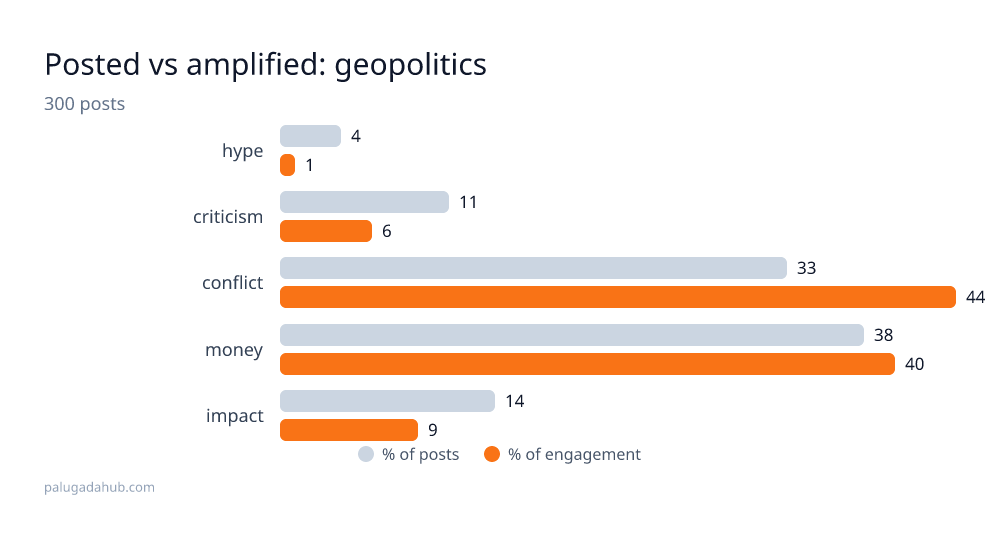
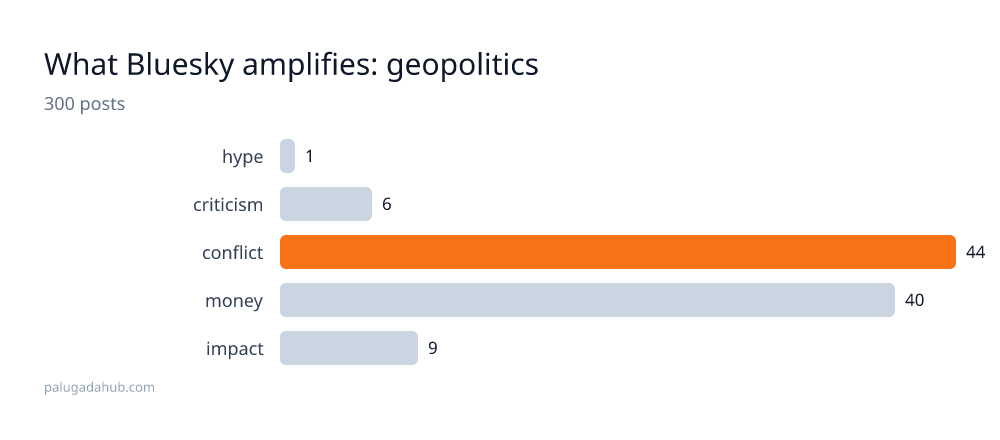
Money frames 38 percent of geopolitics posts on Bluesky, but conflict frames capture 44 percent of the network's engagement. The inversion is stark: what the network posts most is not what it amplifies most.
Across 300 posts over 14 days, the split between posted and amplified frames reveals a consistent pattern. Posts weighted by engagement show conflict and power dynamics pulling disproportionate attention, while business and money angles, though posted more often, underperform their share of the conversation.
| Frame | Posts (%) | Engagement Share (%) | Gap |
|---|---|---|---|
| Money / Business | 38 | 40 | +2 |
| Conflict / Power | 33 | 44 | +11 |
| Impact / Human | 14 | 9 | -5 |
| Criticism / Backlash | 11 | 6 | -5 |
| Hype / Optimism | 4 | 1 | -3 |
The data come from 104 posts classified by frame across the full 300-post sample, with engagement weighted by likes, reposts, and replies. Of the 128 posts carrying a news link, BBC.com led with 12 shared articles, followed by Europesays.com with 11 and Byteseu.com with 10. The single most-amplified link was a Times Higher Education article on UK universities cutting geography, which drew 102 engagements alone.
Conflict frames outperform their posted share by 11 percentage points, suggesting the network's users engage more actively with power struggles and adversarial narratives than with economic analysis. Money frames, by contrast, post at a higher rate than they engage, indicating that while business angles are common, they do not sustain the same level of network response. Impact and human-centered frames lag both their posted share and conflict engagement, capturing only 9 percent of engagement despite representing 14 percent of posts.
Why it matters
The gap between what gets posted and what gets amplified shapes which narratives dominate a network's information diet. When conflict frames drive engagement despite lower post volume, they become the network's de facto editorial priority, regardless of what individual posters intend. This mechanism favors dramatic power narratives over granular economic analysis, even in a category like geopolitics where both matter. The implication for news consumption: Bluesky's geopolitics conversation may skew toward confrontation and away from the structural forces that drive policy.
Who it's for
Journalists covering geopolitics should note which frames their outlets' stories receive. If a business-focused piece lands on Bluesky but conflict-heavy reporting gets amplified, the network's signal is not neutral. Policy researchers and think tanks tracking information flows will find this useful as a baseline for how different analytical frames compete for attention in early-adopter networks.
When and where
This analysis covers 14 days of English-language posts tagged "geopolitics" on Bluesky. The sample includes 300 posts, of which 104 were classified by frame and 128 carried a news link. BBC.com, Europesays.com, and Byteseu.com were the most-shared domains, suggesting a mix of mainstream and specialist outlets.
How
The method is descriptive frame analysis with engagement weighting. Posts were classified by narrative frame (conflict, money, impact, criticism, optimism) using regex and keyword matching on post text and headlines. Engagement was summed as likes plus reposts plus replies, then aggregated by frame to calculate the share of total engagement each frame received. The comparison between posted share (what percent of posts use each frame) and engagement share (what percent of engagement each frame receives) reveals the network's amplification bias. One caveat: frame classification at scale relies on keyword matching and may miss nuanced or hybrid framings; the 104 classified posts represent a subset of the full 300, so the frame distribution is indicative, not exhaustive.
The takeaway
In early-adopter networks, engagement does not follow post volume. Conflict narratives outpull their posted share, while economic analysis underperforms. This is not unique to geopolitics, but it is measurable here. The lesson: when analyzing what a network "cares about," weighted engagement is a better signal than raw post count, and the gap between the two reveals the network's true editorial bias.
Building an AI agent?
I'm packaging how I ship them into one kit. Early access:
AI Agent Starter Kit →