One Newsweek Story Captured a Third of Press-Freedom Debate on Bluesky
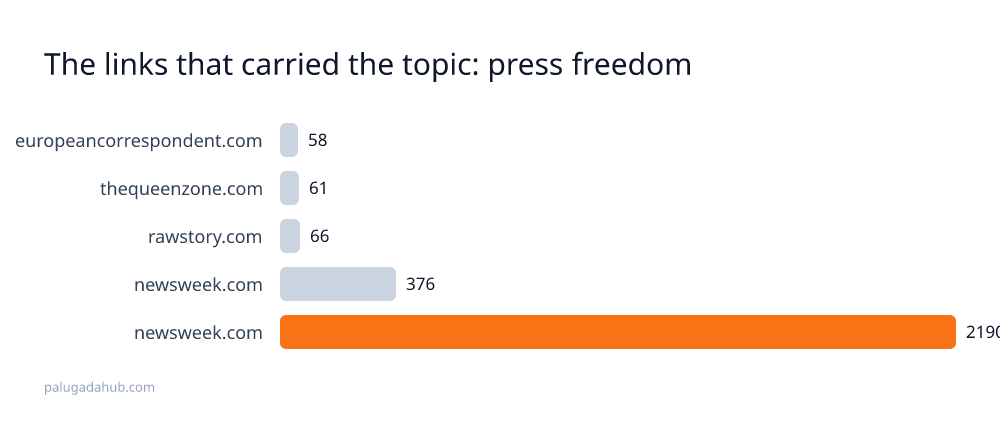
A Newsweek story about Jason Watson, an Air Force major arrested after protesting Trump, accumulated 2,190 engagements across two posts, capturing one-third of all amplification in a 14-day press-freedom conversation that spanned 300 posts. The outsized concentration around a single narrative suggests Bluesky's press-freedom discourse is less about institutional defense of journalism and more about documenting state overreach against individual dissent.
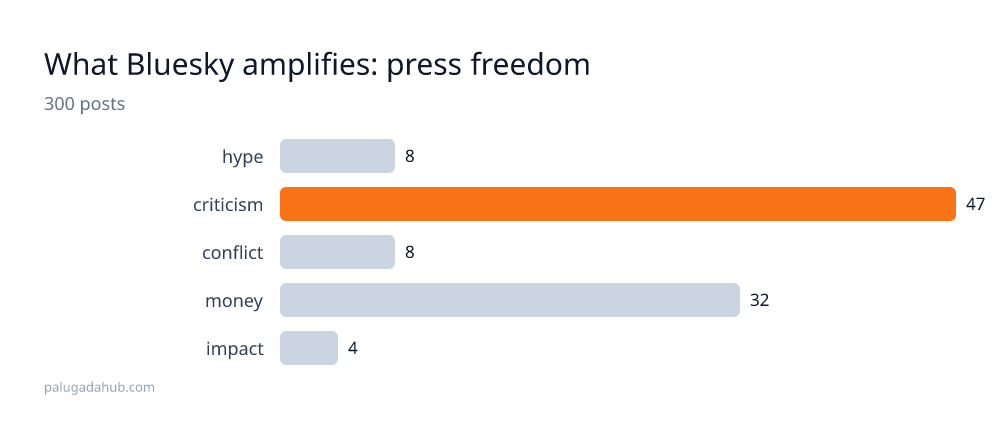
The imbalance between what the network posts and what it amplifies reveals the real priority. Conflict-and-power framing dominated by post count, at 30 percent of the 92 classified posts, yet criticism-and-backlash frames captured 47 percent of total engagement. The money-and-business frame, which typically anchors institutional press analysis, pulled 32 percent of engagement despite only 23 percent of posts. Human-impact framing, the traditional heart of press-freedom journalism, registered just 4 percent of engagement despite 12 percent of posts.
| Frame | Posts (%) | Engagement (%) | Gap |
|---|---|---|---|
| Conflict / Power | 30 | 8 | -22 |
| Criticism / Backlash | 19 | 47 | +28 |
| Money / Business | 23 | 32 | +9 |
| Impact / Human | 12 | 4 | -8 |
| Hype / Optimism | 16 | 8 | -8 |
The Watson story worked because it collapsed press freedom into a single, legible act of state power: arrest after dissent. It required no institutional knowledge, no debate about media ownership or editorial independence. The network amplified it not because it defended journalism but because it documented what felt like retaliation. The second-most-amplified link, also from Newsweek, about Trump forcing disclosure of "his darkest secrets," followed the same logic: individual exposure, not institutional principle.
Domains tell the same story. Europesays.com, a geopolitical commentary site, led the shared-link count at six posts. Courthouse News, a legal-reporting outlet, appeared four times. Neither is a traditional press-freedom organization. The AP and Dallas News each appeared three times. The network was not routing readers to press-freedom advocacy groups or journalism-industry analysis; it was sharing legal documents, court reporting, and political commentary.
Why it matters
Press freedom on Bluesky has become a proxy for state accountability rather than a defense of journalism as an institution. This reframing has consequences. It means the network amplifies individual cases of alleged overreach but may underamplify structural threats to press independence: ownership consolidation, advertiser pressure, or editorial interference that does not result in arrest. The 4 percent engagement share for human-impact framing suggests stories about what censorship costs ordinary people, or how press restrictions affect reporting quality, are not resonating. The network is watching power, not protecting journalism.
Who it's for
Press-freedom advocates and journalists monitoring how social networks frame threats to their work. Also relevant to researchers tracking how decentralized networks like Bluesky reframe civic concepts away from institutions and toward individual acts of dissent.
When and where
Data spans 14 days of English posts tagged "press freedom" on Bluesky, analyzed via searchPosts with engagement-weighted classification of 92 posts that carried news links. The sample includes 91 posts with external links from 300 total posts; the remaining 209 posts were text-only or link-free.
How
Method: descriptive statistics on engagement share by frame, post-count distribution across frames, and domain frequency. Posts were classified into five frames (hype, criticism, conflict, money, impact) via regex pattern-matching on headlines and post text. Engagement was weighted equally across likes, reposts, and replies. The caveat: frame classification is automated and coarse; a post about arrest might carry both conflict and human-impact elements, but was sorted into one bucket. The Newsweek story appeared twice in the top-engagement list, suggesting either reposting or separate posts with the same link; the 2,190 figure represents a single post's engagement, not duplicate counting.
The takeaway
When a single link captures one-third of network engagement on a topic, it signals not breadth but resonance with a specific narrative. Bluesky's press-freedom conversation is not distributed; it is anchored to individual acts of state power. This mirrors a broader pattern in decentralized networks: they amplify scandal and dissent faster than they amplify institutional analysis. If press freedom is to be defended, the network will need to boost the institutional and structural stories that do not fit neatly into a single arrest.
Building an AI agent?
I'm packaging how I ship them into one kit. Early access:
AI Agent Starter Kit →