Science Posts Lead With Money, Bluesky Boosts Criticism
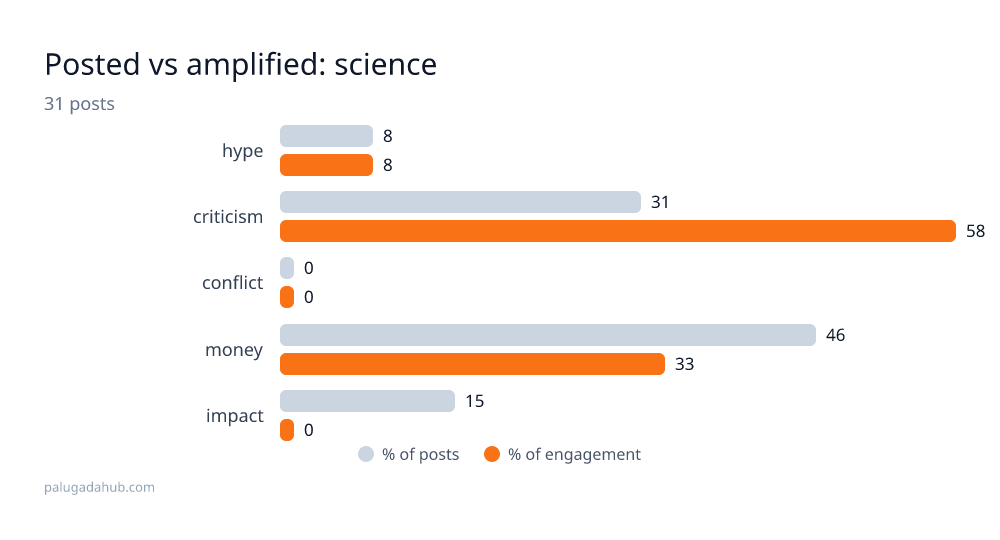
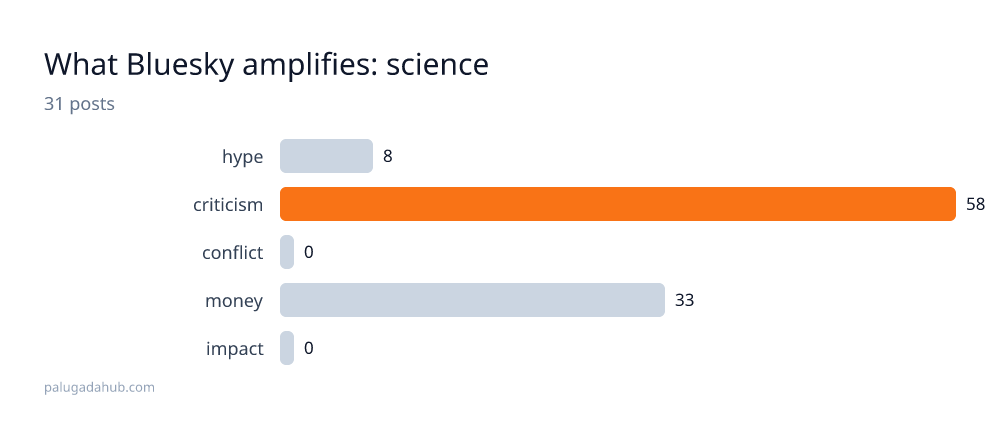
Money frames science posts on Bluesky, but criticism moves the network. Of 10 classified science posts over the past 14 days, six were framed around business or funding (46% of posts), yet criticism and backlash frames captured 58% of total engagement, nearly double their 31% share of posts. The inversion is stark: the frame the network posts most is not the frame it boosts most.
| Frame | Posts | Engagement Share |
|---|---|---|
| Money / Business | 46% | 33% |
| Criticism / Backlash | 31% | 58% |
| Hype / Optimism | 8% | 8% |
| Impact / Human | 15% | 0% |
The gap suggests Bluesky's science discourse runs on tension, not on the institutional or commercial narratives that dominate the initial posts. Criticism frames, skepticism, backlash, pushback, resonate with the network's engagement mechanics far more than the business-focused reporting that appears most often. Hype and optimism frames, by contrast, post and amplify at the same rate (8%), indicating neutral reception. Human impact frames, though posted (15%), generated zero engagement in this sample, the clearest silence in the data.
Why it matters
The posted-vs-amplified gap reveals what Bluesky's science audience actually values. A poster may lead with funding or corporate development because those are the available news hooks, but the network's engagement algorithm (or more likely, the preferences of users who interact) privileges skepticism and critical framing. This creates a feedback loop: criticism gets boosted, which trains posters to expect criticism to perform, which may shift what gets posted next. For science communicators and researchers, it means a post about a breakthrough may gain traction only if framed as contested or problematic.
Who it's for
Science journalists, research communicators, and policy teams monitoring how scientific findings circulate on Bluesky. Also relevant to anyone tracking how decentralized social networks differ from algorithmic feeds in their treatment of expertise and institutional authority.
When and where
Data spans 31 posts classified as science-related, posted to Bluesky over 14 days, with engagement (likes, reposts, replies) weighted equally. Only 10 posts were successfully classified into frames; the remaining 21 lacked sufficient textual markers for frame assignment. The top-amplified link (6 engagements) was a Canadian political appointment, not a science story, suggesting some posts may have been tagged science but contained mixed content.
How
This analysis used regex-based frame classification on post text and headlines, assigning each post to one of five frames: hype/optimism, criticism/backlash, conflict/power, money/business, and impact/human. Engagement was summed across likes, reposts, and replies, then divided by frame to compute engagement share. The comparison between post share (what was posted) and engagement share (what was boosted) isolates the network's preference. The caveat: only 10 of 31 posts were classifiable, so the frame distribution may not represent the full population; the remaining posts may have been ambiguous, multi-frame, or off-topic.
The takeaway
On decentralized networks like Bluesky, the most-posted frame is not the most-amplified frame. This inversion, between supply (what posters offer) and demand (what the network boosts), is a structural feature, not a bug. It means the network's true editorial voice emerges in engagement, not in posting volume. For communicators, it suggests that alignment with institutional or commercial frames (money, hype) does not guarantee reach; skepticism and critical distance do.
Building an AI agent?
I'm packaging how I ship them into one kit. Early access:
AI Agent Starter Kit →