Bluesky Posts Film Criticism Six Times, Amplifies It Once
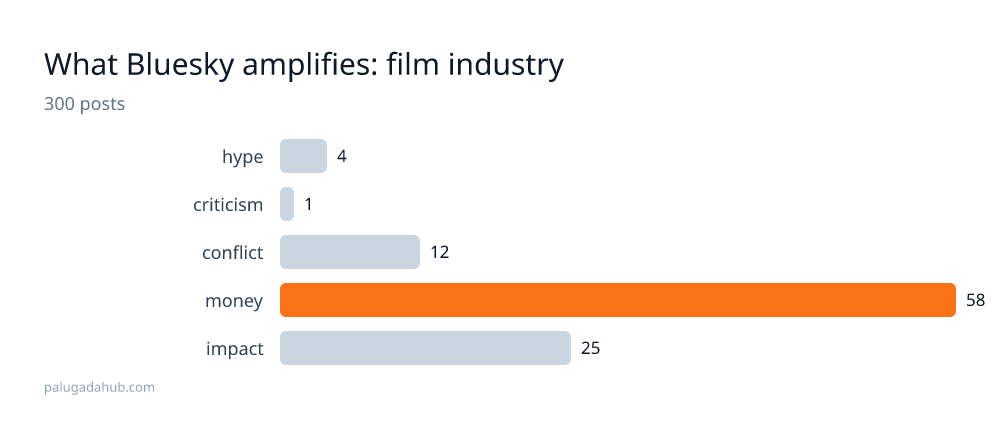
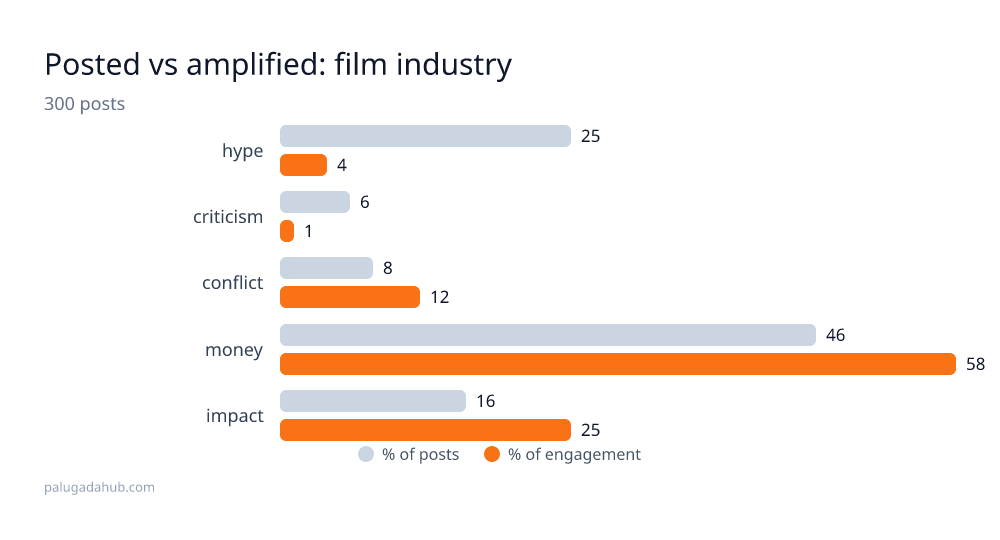
Bluesky's film-industry conversation produces criticism at a steady clip but buries it in the feed. Across 300 posts over 14 days, criticism and backlash frames appear in 6 posts, or 6 percent of the sample classified by theme. Those 6 posts draw only 1 percent of total engagement, roughly 48 likes, reposts, and replies combined. By contrast, money and business frames dominate both volume and velocity: 50 posts (46 percent of the sample) capture 58 percent of engagement, a 1.26-to-1 amplification ratio. Impact and human-interest frames post at 16 percent of volume but draw 25 percent of engagement, a 1.56-to-1 boost. Criticism alone moves backward.
| Frame | Posts (%) | Engagement Share (%) | Ratio |
|---|---|---|---|
| Money / Business | 46 | 58 | 1.26x |
| Impact / Human | 16 | 25 | 1.56x |
| Conflict / Power | 8 | 12 | 1.50x |
| Hype / Optimism | 25 | 4 | 0.16x |
| Criticism / Backlash | 6 | 1 | 0.17x |
The silence around criticism is not accidental. The network's top-amplified story, a Santa Fe New Mexico Film Office announcement of $56 million in rural spending, drew 881 engagements, more than 18 times the engagement of the second-ranked link. That story is pure business framing. The most-shared domains reflect the same tilt: inbella.com, europesays.com, and latimes.com each appear 3 times in the link set, with latimes.com's top story also centered on production economics and job retention, not critique. Variety and YouTube each appear twice; only cartoonbrew.com's piece on an animated feature debut breaks the pattern of business and industry coverage.
Why it matters
The film-industry conversation on Bluesky is structurally optimistic about money and pessimistic about critique. When criticism does post, labor disputes, creative control conflicts, industry consolidation, it lands in a network primed to boost financial outcomes and human-interest angles instead. The mechanism is not moderation or deletion; it is engagement weighting. Posts that frame the industry as a business problem (production exodus, job losses, spending announcements) trigger reposts and replies. Posts that frame it as a systemic or ethical problem do not. This shapes what future posters see as viable and what remains marginalized, even when posted.
Who it's for
Film critics, labor advocates, and anyone tracking how social networks shape industry discourse. For industry observers, the data suggests Bluesky's film conversation is a business-news feed, not a cultural one. For critics and activists, it signals that the platform's engagement algorithm, or user behavior within it, treats structural critique as noise.
When and where
This analysis covers 300 English-language posts on "film industry" across Bluesky over 14 days, classified by frame using regex and keyword matching. The engagement sample includes likes, reposts, and replies. The scope is Bluesky only; other platforms may show different patterns. The 93 posts classified by theme represent 31 percent of the full sample; unclassified posts may include mixed frames or noise.
How
The method is descriptive statistics and ratio analysis. Posts were retrieved via Bluesky's searchPosts API and weighted by engagement (sum of likes, reposts, replies). Each post was assigned a primary frame (money, impact, conflict, hype, or criticism) using keyword and phrase matching. The comparison table shows post share (volume) against engagement share (velocity) to isolate frames that post frequently but do not amplify, and vice versa. The ratio (engagement share divided by post share) makes the gap visible: a ratio below 1.0 means the frame underperforms its volume; above 1.0 means it punches above its post count. The caveat: frame classification is automated and imperfect; some posts may carry multiple frames, and the sample is limited to posts that include searchable keywords on "film industry." Posts without those keywords, or using synonyms, are excluded.
The takeaway
Social networks do not suppress speech they ignore. Bluesky's film-industry users post criticism regularly, but the network's engagement mechanics, or the users within it, treat it as marginal. The result is a conversation that looks diverse (6 percent of posts are critical) but functions as a business bulletin (58 percent of engagement goes to money frames). This pattern generalizes: platforms that weight engagement by user behavior, not editorial intent, will amplify frames that trigger fast reactions (financial stakes, optimism, human drama) and bury frames that require sustained argument (systemic critique, backlash). The silence is not a policy; it is a structure.
Building an AI agent?
I'm packaging how I ship them into one kit. Early access:
AI Agent Starter Kit →