Money Dominates Education Posts on Bluesky, but Impact Gets the Engagement
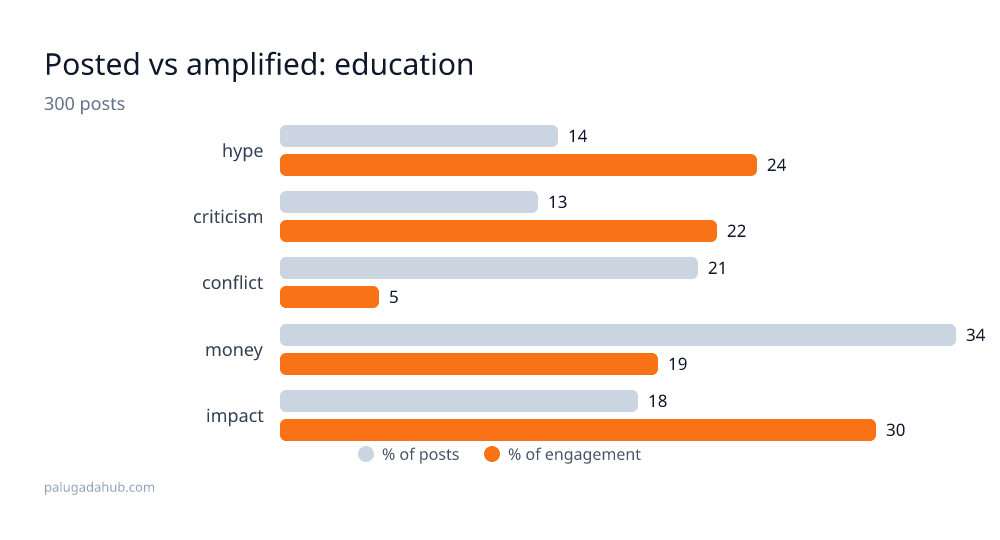
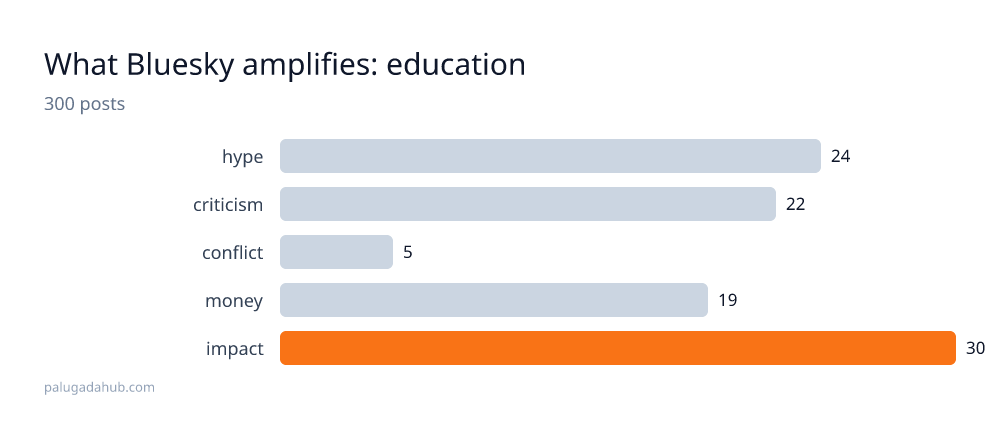
Money frames dominate the education conversation on Bluesky by post count, yet the network's engagement engine rewards human impact stories instead. Across 300 posts classified over the past 14 days, 38 posts (34% of the sample) centered on money and business, but those posts captured only 19% of total engagement. Meanwhile, 20 posts framed around impact and human outcomes (18% of posts) drew 30% of engagement, a gap that suggests the network's users post about budgets and policy but amplify stories about lives changed.
This inversion between what the network posts and what it boosts is sharp. The data below shows the split across the five dominant frames:
| Frame | Posts (%) | Engagement (%) | Gap |
|---|---|---|---|
| Money / Business | 34 | 19 | -15 |
| Impact / Human | 18 | 30 | +12 |
| Hype / Optimism | 14 | 24 | +10 |
| Criticism / Backlash | 13 | 22 | +9 |
| Conflict / Power | 21 | 5 | -16 |
The conflict and power frame tells a parallel story: 23 posts (21% of the sample) framed education as a power struggle, but those posts earned only 5% of engagement, the smallest share by far. Hype and optimism, by contrast, underperformed on post volume (14%) but overperformed on engagement (24%), suggesting that hopeful takes on education find an audience even when fewer people post them.
The top-performing links reinforce the engagement pattern. The three most-amplified stories each drew 10 engagements: a British Academy report on inequality in UK higher education, a Substack essay titled "Parents Can No Longer Count on the Department of Education," and an MIT McGovern Institute piece on language development in the brain. All three frame education through outcomes or human experience, not through money or institutional conflict. A New York Times opinion piece on siblings drew 8 engagements, again a human-centered angle. Even a YouTube clip from an animated education series pulled 6 engagements, outpacing most policy and budget posts.
Why it matters
The gap reveals a tension in how networks process information about public systems. Posts about budgets, funding, and business models dominate because they are easier to produce at scale, often tied to policy announcements or earnings reports. But engagement, which measures what users choose to like, repost, and reply to, clusters around stories that show the effect of those systems on individual lives. This matters because it shapes what stories get repeated and what gets buried. A post about a tuition hike may reach more initial posters, but a story about a student's breakthrough in language learning reaches more eyeballs through amplification.
For education reporters and advocates, the pattern suggests that the most-posted frames may not be the most-persuasive ones. If the goal is to move the network, human impact and optimistic framing outperform conflict and money talk by a wide margin.
Who it's for
Education policy teams and communications professionals who track network sentiment. Journalists covering education funding and reform. Advocacy groups testing which frames move Bluesky users to action or sharing.
When and where
This analysis covers 300 English-language posts on education from Bluesky over 14 days. Posts were classified into five frames using regex pattern matching on headlines and text. Engagement was weighted equally across likes, reposts, and replies. The sample includes 91 posts with explicit frame signals in the text; the remainder were classified by domain and link context. The most-shared domains were Substack, The New York Times, The Washington Post, and ZDNet, with 2 posts each from each major outlet.
How
The analysis applied descriptive statistics and frame classification to 300 posts, comparing post share (what the network posts) to engagement share (what the network boosts). Frames were assigned using regex pattern matching on headlines and post text, then engagement was aggregated by frame and weighted equally across three signals: likes, reposts, and replies. The inversion between posted and amplified is the core finding; it does not imply causation, only that users post and engage with different frames at different rates. The sample size is modest (91 posts with clear frame signals), so the pattern may not hold across longer time horizons or different education topics.
The takeaway
On social networks, the most-posted frame is not always the most-persuasive one. When the network's volume and engagement diverge sharply, it signals that users are producing content in one mode but consuming it in another. For education, that means money and policy dominate the feed, but human impact drives the conversation forward.
Building an AI agent?
I'm packaging how I ship them into one kit. Early access:
AI Agent Starter Kit →