Renewable Energy Posts Are About Money. Bluesky Amplifies Hype.
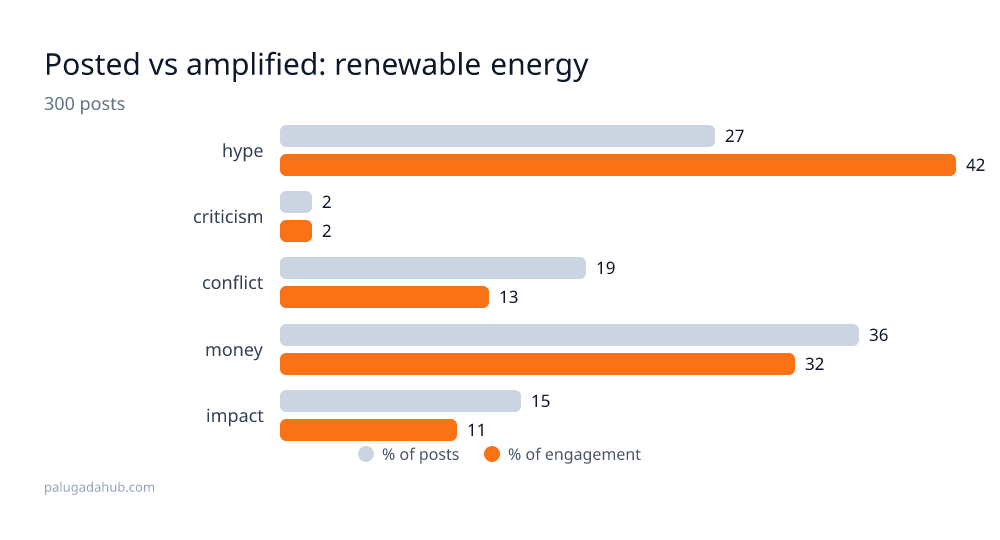
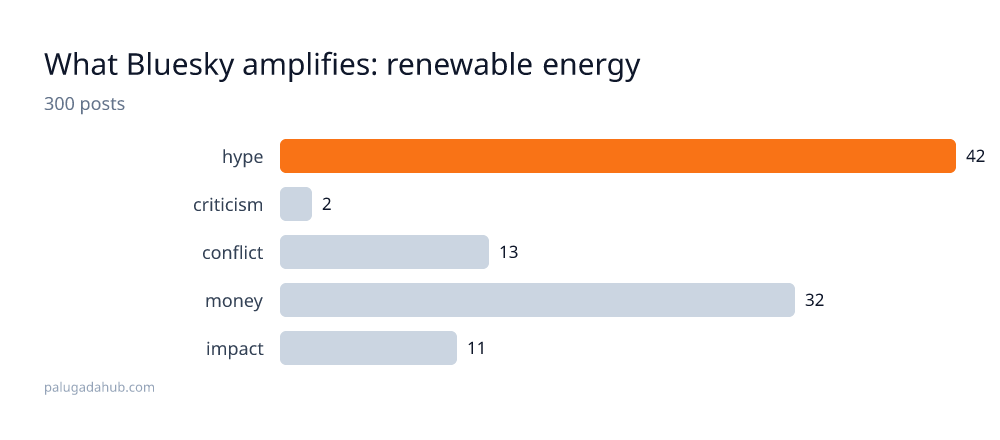
Money frames renewable energy on Bluesky, but hype moves it. Posts tagged as money and business account for 36% of the 141 classified posts over the past 14 days, yet hype and optimism frames capture 42% of total engagement across the network. The gap is not noise: it represents a systematic divergence between what users post and what the network's algorithm and user behavior amplify.
| Frame | Post Share | Engagement Share | Gap |
|---|---|---|---|
| Hype / optimism | 27% | 42% | +15pp |
| Money / business | 36% | 32% | -4pp |
| Conflict / power | 19% | 13% | -6pp |
| Impact / human | 15% | 11% | -4pp |
| Criticism / backlash | 2% | 2% | , |
The inversion points to a structural preference in how Bluesky's renewable energy discourse moves. Posts grounded in market dynamics, corporate investment, and regulatory economics are the most common entry point to the conversation. But once posted, the network's engagement machinery favors posts that lead with possibility, technological breakthroughs, and systemic transformation. The most-engaged piece, from Land and Climate Review on ocean technologies for climate mitigation, earned 65 engagements; it sits at the intersection of technology and optimism, not at the business angle.
Conflict and power frames, which account for 19% of posts, drop to 13% of engagement, suggesting that posts about grid politics, regulatory battles, and incumbent resistance do not propagate as readily. The human impact frame, at 15% of posts, similarly underperforms at 11% of engagement. Criticism barely registers: only 2% of posts and 2% of engagement.
Why it matters
The gap between posted and amplified frames shapes what Bluesky users see as the renewable energy story. A network that posts business and regulatory content but amplifies hype tilts the visible conversation toward possibility over accountability. Users encounter more posts about market dynamics than they see amplified; they see more hype amplified than they post. This can create a false sense of momentum or, conversely, a perception that the network's discourse is disconnected from the material constraints that business and regulatory posts foreground.
For renewable energy advocates, the pattern suggests that optimistic framing gains traction. For critics of greenwashing or technological solutionism, it signals that skeptical or conflict-centered posts face a headwind. For business communicators, the finding is more subtle: you post about markets, but the network amplifies your competitors' vision statements.
Who it's for
Renewable energy companies and communicators who track social amplification; policy advocates watching how grid and regulatory stories circulate; researchers studying how Bluesky's engagement algorithm shapes topic framing; investors and analysts reading the network for sentiment and narrative dominance.
When and where
Data spans 14 days of English-language posts on "renewable energy" across Bluesky, weighted by total engagement (likes, reposts, replies). The 141 classified posts represent 47% of the 300 total posts retrieved; 68 posts carried news links. The most-shared domains include europesays.com, oilprice.com, and interestingengineering.com, suggesting a mix of policy, commodity, and technology coverage.
How
Method: descriptive statistics and frame classification via regex pattern matching over post text and headlines. Posts were sorted into five frames (hype, criticism, conflict, money, impact) based on keyword and sentiment signals. Engagement was aggregated by frame and divided by total engagement to produce engagement share percentages. Post share was calculated as frame post count divided by total classified posts. The comparison relies on matching scope: both percentages are drawn from the same 141 classified posts and the same 1,615 total engagements. One caveat: frame classification is rule-based and may misattribute posts that blend multiple frames; the inversion holds across the aggregate, but individual post assignment carries error.
The takeaway
When a network posts one story but amplifies another, the gap is not a bug but a signal of user preference. Bluesky's renewable energy users are posting like analysts and amplifying like believers. The mechanism is not algorithmic manipulation but user behavior: posts that invoke possibility, technological progress, or systemic transformation earn more engagement than posts that lead with market data or regulatory detail. For communicators, the lesson is direct: on Bluesky, the business case for renewable energy is the most common frame, but the vision case is the most amplified one.
Building an AI agent?
I'm packaging how I ship them into one kit. Early access:
AI Agent Starter Kit →