Public Health Posts Amplify Impact Over Ideology on Bluesky
One New York Times story about flu vaccine hesitancy at an Air Force base drew 476 engagements, nearly six times the runner-up link. That single piece, posted to Bluesky's public health conversation, signals what the network actually amplifies: direct human consequence, not debate about systems or ideology.
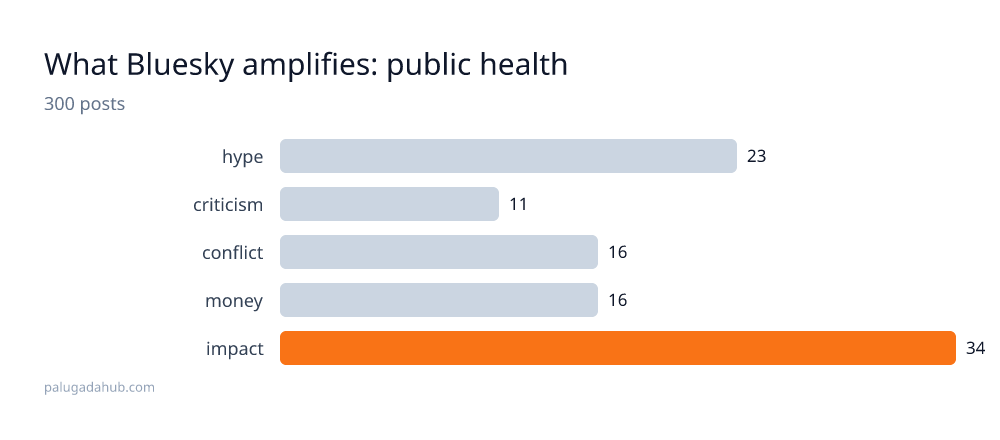
Across 300 posts classified over 14 days, the impact/human frame dominated engagement at 34%, even though it represented only 40% of all posts. By contrast, posts framed as business/money and conflict/power each made up 23% and 17% of the volume but captured only 16% of engagement each. Hype and optimism posts, the smallest category by volume at 11%, still pulled 23% of engagement, suggesting novelty and upside carry weight. Criticism and backlash, at 10% of posts, drew 11% of engagement.
| Frame | Posts (%) | Engagement Share (%) | Gap |
|---|---|---|---|
| Impact / Human | 40 | 34 | -6 |
| Hype / Optimism | 11 | 23 | +12 |
| Conflict / Power | 17 | 16 | -1 |
| Money / Business | 23 | 16 | -7 |
| Criticism / Backlash | 10 | 11 | +1 |
The gap is small but directional. Business-framed posts, which dominated the volume (28 of 108 classified posts), underperformed their share by 7 percentage points. Impact posts slightly underperformed their volume share, but the underperformance was marginal, suggesting the frame is stable and trusted rather than viral.
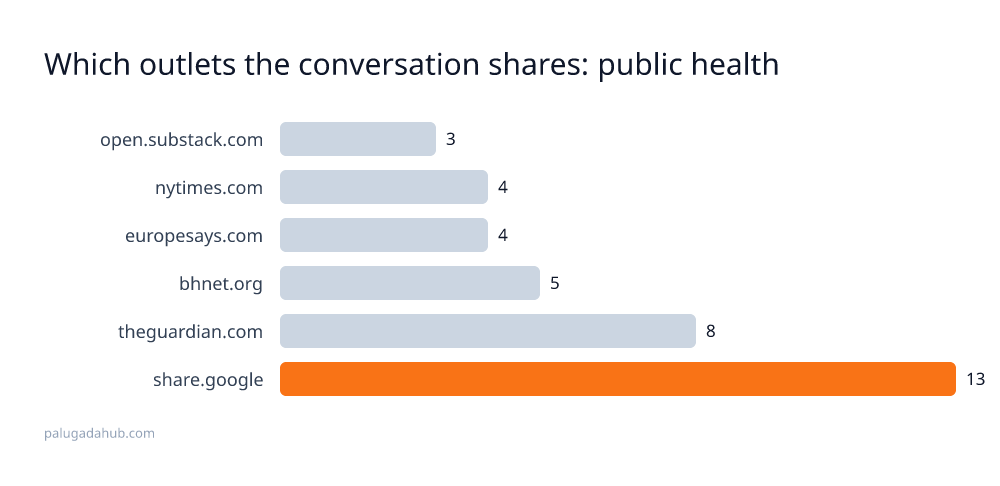
The most-shared domains reinforce this. The New York Times piece on vaccine hesitancy and concrete harm led by a wide margin. Substack posts from epidemiologists and policy analysts, "The irony of the hantavirus quarantine" and MAHA activist backlash, pulled strong engagement despite modest post counts. Google Sheets links, often carrying data or tracking tools, captured the largest domain share (13 posts), suggesting the network values evidence and transparency over opinion.
Why it matters
Public health discourse on Bluesky is not driven by business incentives or power struggles, the frames that dominate traditional news cycles. Instead, the network amplifies posts that name human risk and consequence. This shapes what stories get repeated, what evidence gets circulated, and which voices, epidemiologists, affected communities, investigative outlets, gain reach. Posts that frame health policy as a market or a political contest for dominance lose traction relative to their volume, which may suppress certain kinds of institutional analysis.
The hype/optimism frame's outsize engagement (12 points above its post share) suggests that when impact stories include a positive development or breakthrough, they amplify further. The Times piece on vaccine hesitancy did not offer hope; it offered alarm grounded in a specific incident. That specificity, not sentiment, appears to drive the network's choices.
Who it's for
Public health communicators, epidemiologists, and journalists covering health policy. If your frame is business efficiency or political conflict, expect your post to underperform its volume share. If your frame is concrete human impact, you are aligned with the network's amplification logic but not guaranteed to break through unless the story carries novelty or an unexpected angle.
When and where
This sample covers 300 posts over 14 days, classified using regex frame detection across headlines and post text. The engagement weighting (likes, reposts, replies) reflects the last 14 days of network activity. The most-shared domains include news outlets (New York Times, National Observer, Bucks County Beacon), independent Substacks, and Google Sheets, suggesting a mix of institutional and grassroots sources.
How
Each post was classified into one of five frames (hype/optimism, criticism/backlash, conflict/power, money/business, impact/human) using keyword and thematic patterns in the headline and post text. Engagement was summed across all posts in each frame and divided by total engagement to calculate the share. The post share was calculated by frame count divided by total classified posts. The comparison table shows where frames outperformed or underperformed their volume share. The caveat: frame classification is rule-based and may misclassify posts with mixed or ambiguous framing; the sample is English-language Bluesky posts only and does not represent the full network or other languages.
The takeaway
When a network's users amplify impact over business and conflict frames, it signals a preference for accountability and consequence over institutional narrative. This is not inevitable; it reflects the composition and values of Bluesky's early public health community. As the network grows, this ratio may shift. For now, the data suggests that public health posts succeed on Bluesky by naming who is harmed and how, not by explaining why institutions compete or markets move.
Building an AI agent?
I'm packaging how I ship them into one kit. Early access:
AI Agent Starter Kit →