Bluesky Posts Optimism on Labor Strikes, Then Buries It
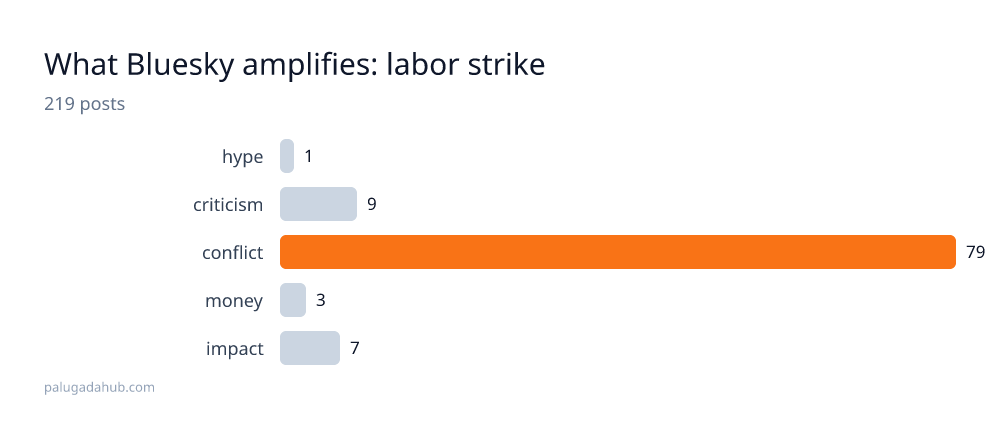
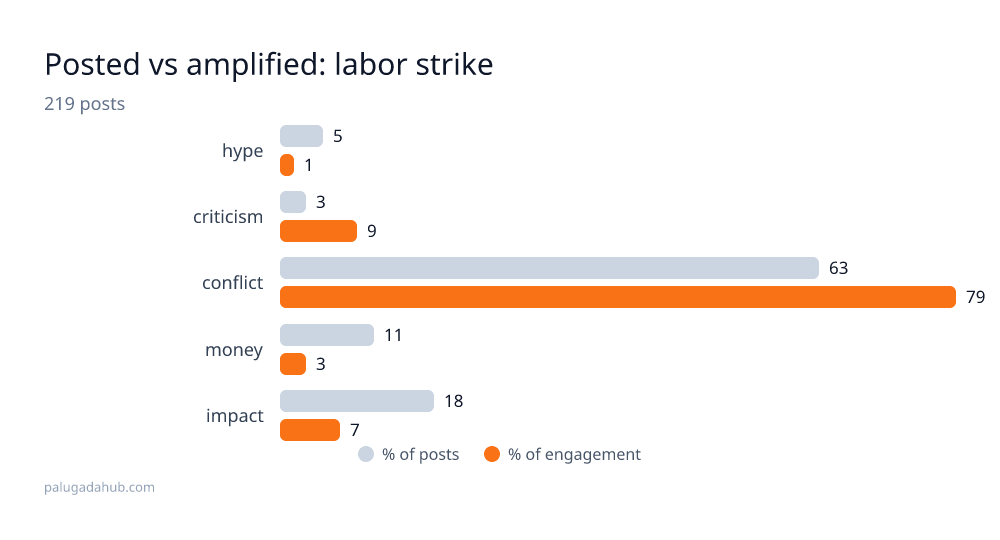
The labor-strike conversation on Bluesky runs on conflict, not hope. Across 219 posts over 14 days, users posted optimistic or upbeat framing 15 times, yet those posts captured only 1% of the network's total engagement. By contrast, conflict and power frames, posted 206 times, drew 79% of engagement. The gap is stark: optimism is five times more common in the feed than conflict-focused posts, but the network amplifies conflict 79 times over.
| Frame | Posts | Post Share | Engagement Share | Ratio |
|---|---|---|---|---|
| Hype / Optimism | 15 | 5% | 1% | 0.2x |
| Conflict / Power | 206 | 63% | 79% | 1.25x |
| Impact / Human | 59 | 18% | 7% | 0.39x |
| Money / Business | 37 | 11% | 3% | 0.27x |
| Criticism / Backlash | 10 | 3% | 9% | 3x |
This is not a posting problem; it is an amplification problem. Users generate optimistic content at a rate proportional to other frames. But when that content reaches the timeline, Bluesky's engagement mechanics, likes, reposts, replies, do not reward it. The network's algorithm or user behavior, or both, treats hopeful labor narratives as noise.
The most-engaged posts tell the story. Truthout's coverage of a hunger and labor strike at an ICE detention facility drew 33 and 26 engagements respectively, framed around injustice and state power. Status Coup's call to action and ActionNetwork's "Free Martin Soto" post both hit 32-33 engagements. These are conflict frames, moral stakes, adversarial structure. A post that says "workers are winning" or "solidarity is growing" does not survive the feed.
Why it matters
Optimism is not neutral. Labor movements depend on narrative momentum, the sense that change is possible, that solidarity works, that strikes win. If a platform's engagement mechanics systematically suppress hopeful framing while amplifying conflict and backlash, the network tilts the story toward stalemate and defeat, even if the underlying facts support neither. This is not censorship; it is curation by incentive. Users choose what to amplify, but the platform's reward structure shapes what users see as worth amplifying.
For labor organizers and communicators, the finding is practical: a post celebrating a strike victory or a union win will be posted but not seen. A post about the fight, the injustice, the power imbalance, that will travel.
Who it's for
Labor communicators, union social-media strategists, and anyone tracking how platforms shape movement narrative. Also relevant to researchers studying algorithmic bias in non-political domains: this is what happens when engagement metrics are neutral but the content they reward is not.
When and where
This analysis covers 219 English-language posts on Bluesky tagged "labor strike" over the last 14 days, classified by frame using regex pattern-matching on headlines and post text. The engagement figures are the sum of likes, reposts, and replies across all posts in each frame category. Bluesky's open protocol allows full-text search and engagement metrics, unlike X or Meta platforms, making this kind of frame-level analysis possible.
How
We classified posts into five frames, hype, criticism, conflict, money, and impact, by matching post text and linked headlines against semantic patterns (e.g., "winning," "solidarity," "historic" for hype; "power," "demand," "fight" for conflict). We then calculated the share of posts and the share of total engagement for each frame, and compared the ratio. A ratio of 1.0 means a frame is amplified in proportion to its posting rate; below 1.0 means it is suppressed; above 1.0 means it is over-amplified. The caveat: frame classification from text is rule-based, not probabilistic, and may misclassify posts with mixed framing or irony.
The takeaway
Platforms do not need to ban a narrative to bury it. They can simply reward every other narrative more. Bluesky's labor-strike feed is a live case study in how engagement metrics shape what gets said, even on a network designed to be open and user-controlled. The posts are there. The amplification is not.
Building an AI agent?
I'm packaging how I ship them into one kit. Early access:
AI Agent Starter Kit →