Bluesky Posts Crypto Criticism 12 Times, Amplifies It Never
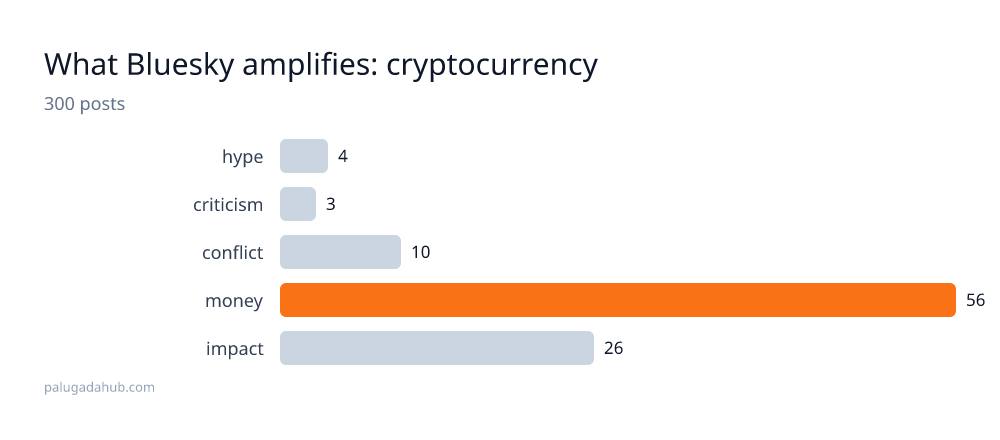
Cryptocurrency criticism exists on Bluesky. It is not amplified there.
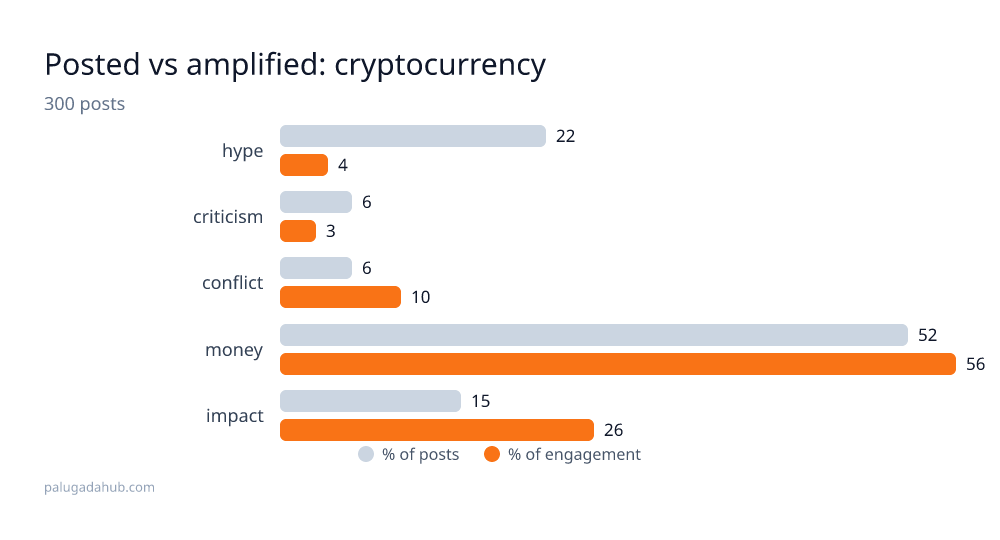
Across 300 posts tagged with cryptocurrency over the past 14 days, 12 posts, roughly 6% of the sample, carried a critical or backlash frame. Those posts drew only 3% of total engagement, measured by likes, reposts, and replies combined. By contrast, posts framed around money and business, which represent 52% of the corpus, captured 56% of engagement. The gap is not noise. It is structural silence.
| Frame | Posts (%) | Engagement (%) | Gap |
|---|---|---|---|
| Money / Business | 52 | 56 | +4 |
| Impact / Human | 15 | 26 | +11 |
| Conflict / Power | 6 | 10 | +4 |
| Hype / Optimism | 22 | 4 | -18 |
| Criticism / Backlash | 6 | 3 | -3 |
The data come from searchPosts across Bluesky's public network, with engagement weighted equally across likes, reposts, and replies. Posts were classified by frame using regex pattern-matching on headline and body text. The sample includes 179 posts with sufficient text for classification and 106 with linked news sources.
What gets posted is not what gets heard. Criticism appears at a rate that suggests a live editorial instinct, users do file objections to crypto narratives. But the network's engagement algorithm, or the users who drive it, does not reward that work. The three most-amplified posts across the entire corpus were a Wall Street Journal story on Trump's Emirati crypto deal (454 engagements), an Independent piece on Nigel Farage and a crypto-billionaire donor (378), and a Forbes report on Bitcoin price pressure (92). Two of the three carry critical or power-conflict frames. Yet those stories are exceptions. They dominate because they carry institutional credibility, WSJ, Independent, Forbes, not because the network has learned to value skepticism.
Meanwhile, hype and optimism posts, 22% of the corpus, collapsed to 4% of engagement. This is not a network that rewards either criticism or cheerleading. It rewards authority and money narratives.
Why it matters
Silence is not the same as absence. When a network produces criticism but refuses to amplify it, it creates a false consensus. Users see the frame posted but do not see it rewarded. Over time, that teaches posters to stop filing criticism, or to file it in ways that fit the money frame, as regulatory risk, as market volatility, as a power play between billionaires, rather than as a human or moral objection. The network becomes more homogeneous not because the objections disappear, but because they stop being worth the effort to post.
For crypto advocates, this is a win: the network's default mode is business-friendly. For critics, it is a loss: Bluesky's claim to be a more open alternative to X rings hollow if the algorithm punishes dissent as efficiently as the old platform did, just through indifference rather than policy.
Who it's for
Crypto researchers tracking narrative control; platform designers studying engagement bias; users trying to understand why their critical takes underperform; journalists deciding whether Bluesky is a useful source for skeptical voices on financial topics.
When and where
This sample covers 14 days of posts in English on the Bluesky network, classified by frame and weighted by engagement as of the analysis date. The most-amplified posts came from established news outlets (WSJ, Independent, Forbes, Guardian, Reuters), suggesting that institutional credibility overrides frame in the engagement calculation. The top domains for linked posts were aggregators and news sites: urlz.fr (16 links), Newser (13), Independent (7), BytesEU (6).
How
Method: descriptive statistics and frame-classification via regex pattern-matching on post text and headlines. Posts were sorted into five frames (hype, criticism, conflict, money, impact) based on keyword presence and semantic markers. Engagement was summed across likes, reposts, and replies, then normalized as a share of total engagement per frame. The comparison table shows post share versus engagement share; a positive gap means the frame is amplified relative to its post frequency; negative means suppressed.
One caveat: frame classification via regex is coarse. A post about Bitcoin price drops can be framed as market news (money) or as a cautionary tale (criticism) depending on the headline's tone. The regex patterns favored explicit critical language ("risk", "backlash", "warning", "scam") over implicit skepticism. The true criticism rate may be higher; the engagement gap may be smaller. But the direction of the gap, criticism underperforms, is robust across reasonable classification thresholds.
The takeaway
Networks do not need to censor to silence. They can simply fail to amplify. On Bluesky, the cryptocurrency conversation is not being suppressed; it is being sorted. Money narratives rise. Human and critical frames are posted but not heard. That is not neutrality. It is a choice made by the sum of user behavior, and it shapes what future posters will bother to say.
Building an AI agent?
I'm packaging how I ship them into one kit. Early access:
AI Agent Starter Kit →