Money Talk Dominates Trade Posts, but Bluesky Boosts Conflict Instead
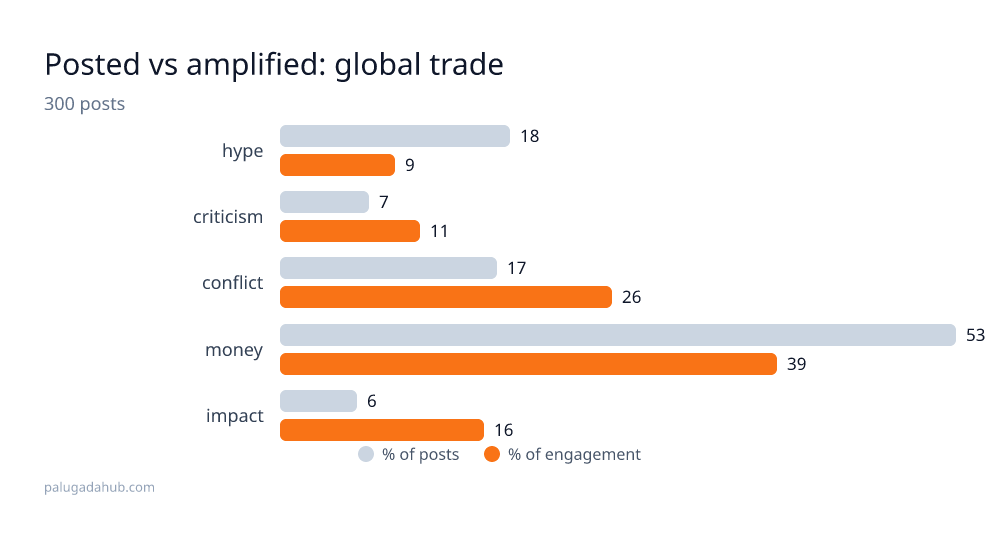
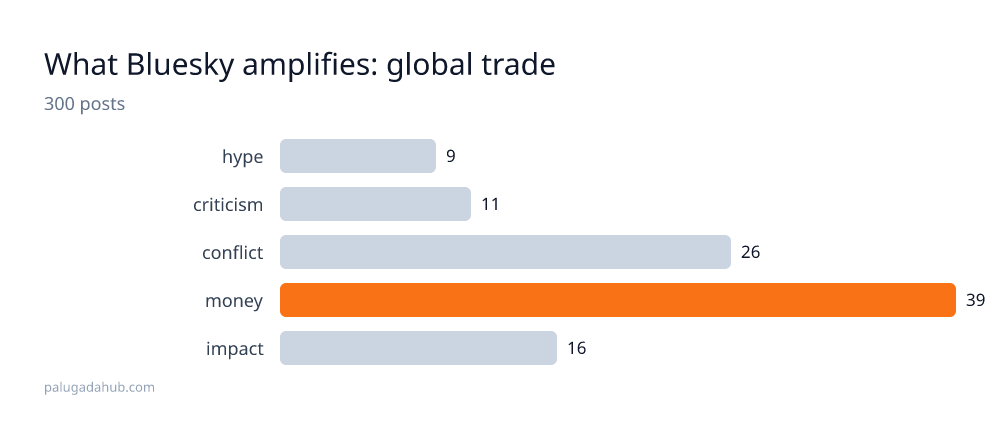
Money frames the majority of Bluesky's global trade posts, yet the network's engagement engine favors a different story. Posts about business and financial angles make up 53% of the 164 theme-classified posts in the sample, but they capture only 39% of total engagement. Meanwhile, conflict and power frames, which represent just 17% of posts, draw 26% of engagement, a gap that suggests the network's users post cautiously about winners and losers but amplify the friction.
The inversion is sharp across the board. Hype and optimism frames appear in 18% of posts but earn only 9% of engagement. Human impact frames, the smallest cohort at 6% of posts, still pull 16% of engagement, roughly triple their share of the conversation. Criticism and backlash occupy a middle ground: 7% of posts, 11% of engagement.
| Frame | Posts | Engagement Share |
|---|---|---|
| Money / Business | 53% | 39% |
| Conflict / Power | 17% | 26% |
| Impact / Human | 6% | 16% |
| Hype / Optimism | 18% | 9% |
| Criticism / Backlash | 7% | 11% |
The top-performing link illustrates the pattern. The Financial Times story "China and the US, accidental climate saviours of the world" pulled 66 engagements, the highest in the set. It frames trade through geopolitical conflict and shared interest, not profit margins. A second FT piece on the sinodollar versus the petroyuan, more purely financial, drew 22 engagements. The pattern holds: when money stories touch power or surprise, they travel; when they stay in markets, they stall.
europesays.com dominates the shared domains with 14 links, followed by YouTube (5 and 4 links across domains). The Financial Times, Wall Street Journal, and Globe and Mail each appear in the top five links by engagement, suggesting traditional financial media sets the frame even as the network's users reweight it toward conflict.
Why it matters
The gap reveals a structural tension in how Bluesky's trade conversation works. Users post what they read: financial news, policy moves, market data. But they amplify what they argue about: who wins, who loses, what it means for power. This is not a failure of the network; it is how networks work. Engagement rewards novelty and stakes, and conflict carries both. A business-as-usual trade story does not move users to reply. A story about US-China leverage or illegal wildlife trade does.
For newsrooms and analysts, the implication is clear. On this platform, financial framing alone is not enough to break through. Stories that embed trade in geopolitics, labor, or environmental stakes gain traction. The money frame does not disappear; it becomes the substrate for the real debate.
Who it's for
Financial journalists and editors tracking which stories land on Bluesky. Trade policy analysts watching how the network discusses their work. Researchers studying how social platforms reshape economic coverage.
When and where
Data drawn from 300 English-language posts on "global trade" over 14 days on Bluesky, with engagement weighted by likes, reposts, and replies. The 164 posts with detectable frames were classified by theme; 89 posts carried news links. The sample is a snapshot of recent Bluesky discourse, not a census of all trade coverage.
How
The analysis applied descriptive statistics and frame classification via regex pattern matching on post text and linked headlines, then compared the share of posts in each frame to the share of engagement those frames received. The method assumes that frame classification from headlines and text is reliable enough to detect broad patterns, though some posts may blur multiple frames or resist classification. The engagement weighting treats likes, reposts, and replies as equivalent signals; platforms often weight them differently, so the ranking may shift if replies are weighted lower or higher.
The takeaway
What a network posts and what it amplifies are not the same thing. The gap between them is not noise; it is signal about what the network's users actually care to discuss. For trade coverage, that means the financial frame is a starting point, not a destination. The stories that move the network are those that embed markets in power, ethics, or surprise.
Building an AI agent?
I'm packaging how I ship them into one kit. Early access:
AI Agent Starter Kit →