Supreme Court Hype Posts Vanish From Bluesky's Feed
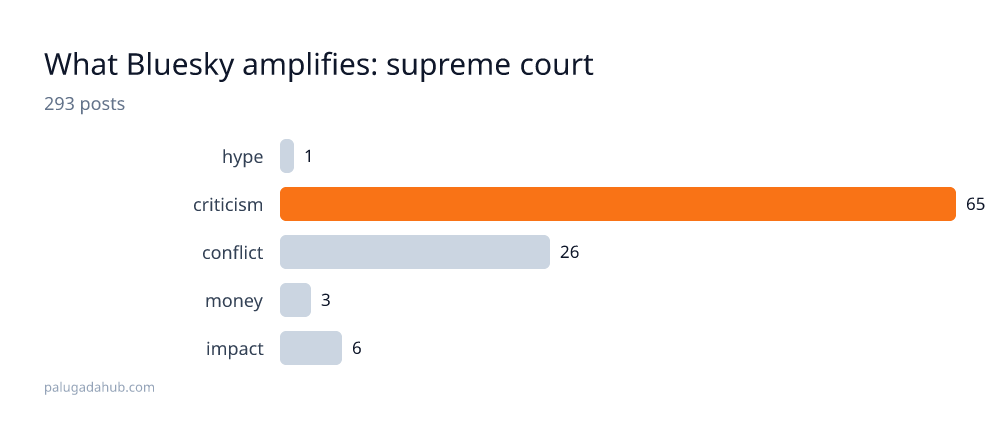
Bluesky users post optimistic takes on the Supreme Court at a steady clip. They almost never read them.
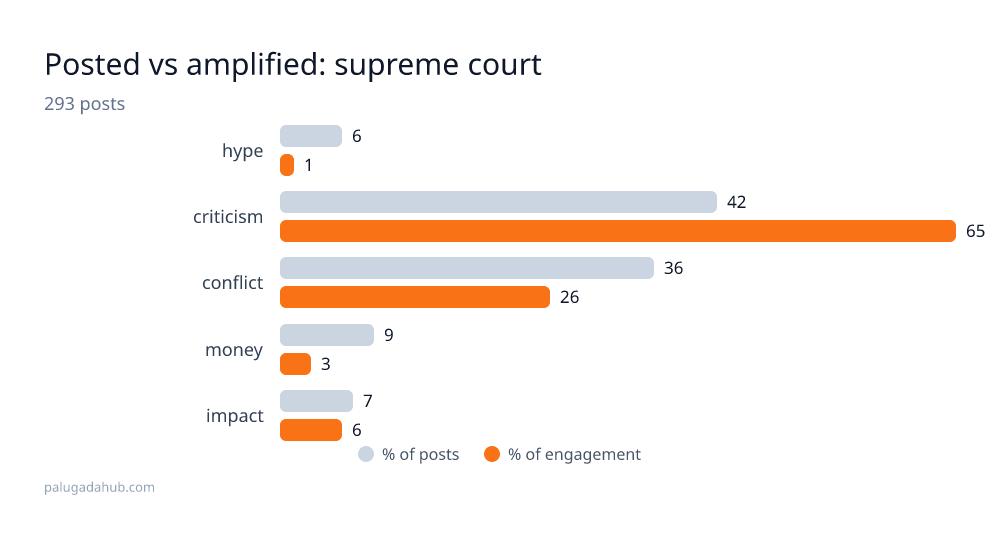
Across 293 posts about the Supreme Court over 14 days, optimistic or hopeful framing appeared in 6 posts, roughly 6% of the sample. Those posts drew only 16 total engagements, or 1% of the 1,677 engagements recorded across the category. By contrast, critical and backlash framing, posted in 46 posts, or 42% of the sample, captured 1,089 engagements, or 65% of the network's total attention.
| Frame | Posts | Post Share | Engagement | Engagement Share |
|---|---|---|---|---|
| Hype / Optimism | 6 | 6% | 16 | 1% |
| Criticism / Backlash | 46 | 42% | 1,089 | 65% |
| Conflict / Power | 39 | 36% | 436 | 26% |
| Money / Business | 10 | 9% | 50 | 3% |
| Impact / Human | 8 | 7% | 101 | 6% |
The silence around optimism is the story. Users post it; the network does not amplify it. Criticism, by contrast, moves in both directions: it is the most-posted frame and the most-amplified one, with a 65-to-42 ratio favoring engagement over volume. Conflict and power dynamics rank second in amplification (26%) despite appearing third in post frequency (36%), suggesting the network boosts structural analysis more than it boosts raw optimism.
The most-shared links tell the same story. The Washington Post's story on a Rastafarian prisoner's failed religious-rights claim drew 16 engagements; NBC's version of the same story drew 14. A Reason magazine piece on a "terrible" takings decision pulled 9. The top five links are all critical or analytical, none celebratory.
Why it matters
Optimism about institutions does not move on Bluesky the way criticism does. This is not a surprise on a network where early adopters skew toward skeptics of legacy media and establishment power. But the scale of the gap, 6% of posts, 1% of engagement, suggests a structural mismatch: the network produces a frame it has no appetite to consume. Users who post hopeful takes on the Court may be speaking to an audience that has already left the room.
The dominance of criticism (65% of engagement) combined with the presence of conflict framing (26%) means roughly 9 in 10 engagements go to posts that either attack the Court or analyze its power dynamics. Money and human impact frames together capture 9%, a reminder that economic and personal stakes are secondary to institutional critique on this network.
Who it's for
Court reporters and institutional communicators should note the environment. Posts framed as "here's what the Court did and why it matters for power" will outperform "here's a win for the institution." Advocacy organizations and legal analysts dominate the conversation; optimists do not.
When and where
This sample covers 14 days of English-language posts on Bluesky tagged or linked to Supreme Court news. The top shared domains are AP News (6 posts), New York Times (5), and CNN (4), with individual stories from Washington Post, NBC, and regional outlets driving the highest engagement. The data reflects searchable, public posts; private conversations and quote-posts without links are not included.
How
We classified 91 of 293 posts by frame using regex pattern matching against post text and headlines, then weighted each frame by total engagement (likes, reposts, replies combined) to measure amplification. Engagement share reflects the proportion of total engagements per frame, not per post; a frame with fewer posts but higher average engagement per post will show higher engagement share. The caveat: frame classification from text is coarse; a post can carry multiple frames, and sarcasm or irony may misclassify. The sample includes only posts with detectable framing signals, so 91 of 293 posts were classified; the remaining 202 were either too brief, too generic, or too ambiguous to assign reliably.
The takeaway
Networks do not amplify all the content they produce. Bluesky users generate optimistic takes on institutions, but the network's engagement engine favors skepticism and structural critique. This is not a moderation choice; it is a preference encoded in who reads and boosts what. Understanding the gap between post volume and amplification is essential for anyone trying to reach an audience on a platform: the frame you post most is not the frame the network will carry.
Building an AI agent?
I'm packaging how I ship them into one kit. Early access:
AI Agent Starter Kit →