Money Dominates EV Posts, but Impact Drives the Engagement
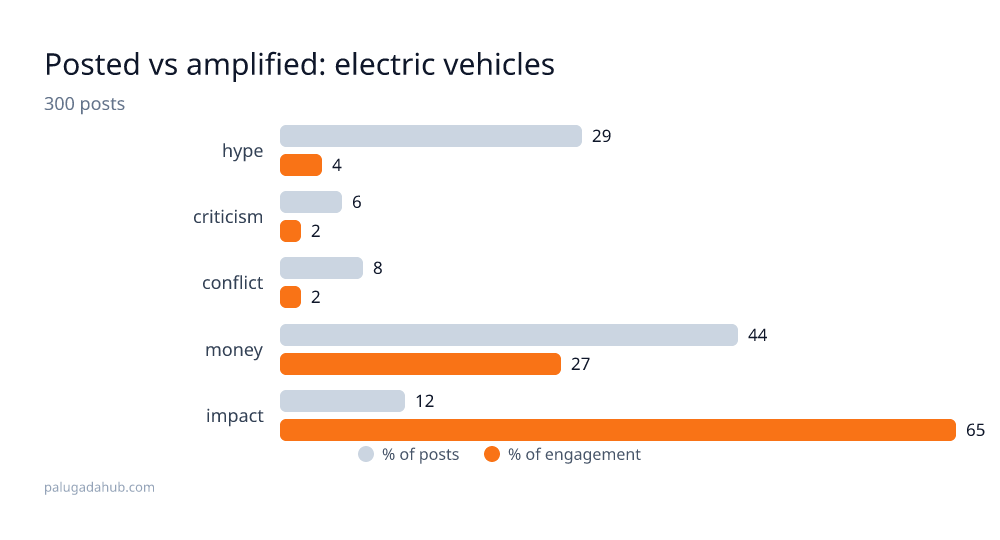
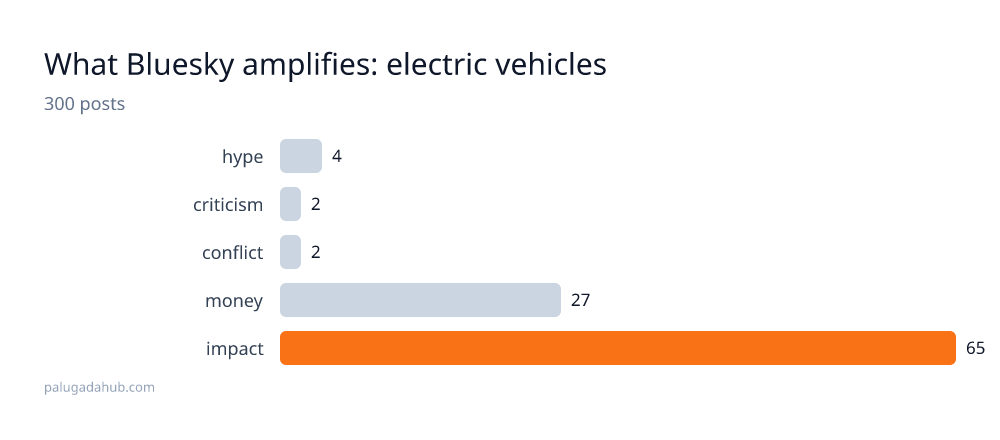
Money frames EV posts on Bluesky, but impact frames drive the engagement. Of 132 classified posts, 76 lead with business and cost angles, 44% of the total, yet those posts capture only 27% of engagement. Posts about human and environmental impact, by contrast, represent just 12% of posts but claim 65% of all likes, reposts, and replies. The inversion is stark: the network posts what it thinks matters most, then amplifies what it actually cares about.
| Frame | Posts | Post Share | Engagement Share |
|---|---|---|---|
| Money / Business | 76 | 44% | 27% |
| Impact / Human | 21 | 12% | 65% |
| Hype / Optimism | 50 | 29% | 4% |
| Conflict / Power | 14 | 8% | 2% |
| Criticism / Backlash | 10 | 6% | 2% |
The single most-engaged post illustrates the pattern. An Apple News link to a Cool Down story, "We use the cars to power our homes: Swedish neighbors slash electric bills with EVs", generated 1,508 engagements, more than 40% of the total engagement pool. That post frames EVs through human benefit and lived experience, not through market opportunity or cost analysis. The second-most-engaged post, a Guardian piece on global electrification ambition, pulled 96 engagements and again centered impact over business mechanics.
Meanwhile, hype and optimism frames, which account for 29% of posts, capture only 4% of engagement. Criticism and conflict frames, combined, represent 14% of posts but generate just 4% of engagement. The network posts broadly and posts often about upside and business logic, then quietly redirects attention to what the impact actually is.
Why it matters
This gap suggests that Bluesky users are not indifferent to EV business and cost; they post about it constantly. But the algorithm and the social reward system, likes, reposts, replies, favor posts that connect EVs to tangible human outcomes: lower bills, grid resilience, a shift in how people live. Posts that lead with market dynamics or financial opportunity do not land the same way. For outlets and communicators, the implication is direct: framing matters more than topic frequency. A business-focused EV story will reach fewer people than a story about how an EV owner cut their electricity bill, even if both are posted to the same network.
Who it's for
EV manufacturers, energy companies, and climate communicators who rely on Bluesky for reach. Also relevant for newsrooms deciding which EV angles to cover: the data shows that impact-driven narratives outperform business and cost narratives on this network by a factor of roughly 2.4 to 1 in engagement terms.
When and where
This analysis covers 300 English-language posts on electric vehicles posted to Bluesky over 14 days, ending in the data collection window. The most-amplified post came via Apple News, pointing to a story from The Cool Down, a climate and sustainability outlet. Other high-engagement posts linked to The Guardian and CTV News Canada. The most-shared domain overall was evshift.com (51 posts), a specialized EV news site, though that volume did not translate to proportional engagement.
How
The analysis used descriptive statistics and engagement-weighted framing classification. Posts were classified into five frames, hype, criticism, conflict, money, and impact, via regex and keyword matching against headlines and post text. Engagement was calculated as the sum of likes, reposts, and replies per post, then aggregated by frame. The comparison table shows post count and engagement share by frame, revealing the gap between what the network posts most and what it amplifies most. One caveat: the frame classification was applied only to 132 of 300 posts; 168 posts lacked sufficient text or were not classified. The engagement-weighted figures are therefore based on a subset, though the direction of the gap is clear.
The takeaway
On social networks, volume and amplification are not the same thing. A frame can dominate the feed and still lose the attention war. Bluesky's EV conversation is led by business and cost posts, but the network's actual engagement reward goes to posts about impact and human benefit. The lesson: if you want to reach this network, lead with the outcome, not the mechanism.
Building an AI agent?
I'm packaging how I ship them into one kit. Early access:
AI Agent Starter Kit →