Bluesky Posts Stock Criticism 11 Times, Amplifies It Never
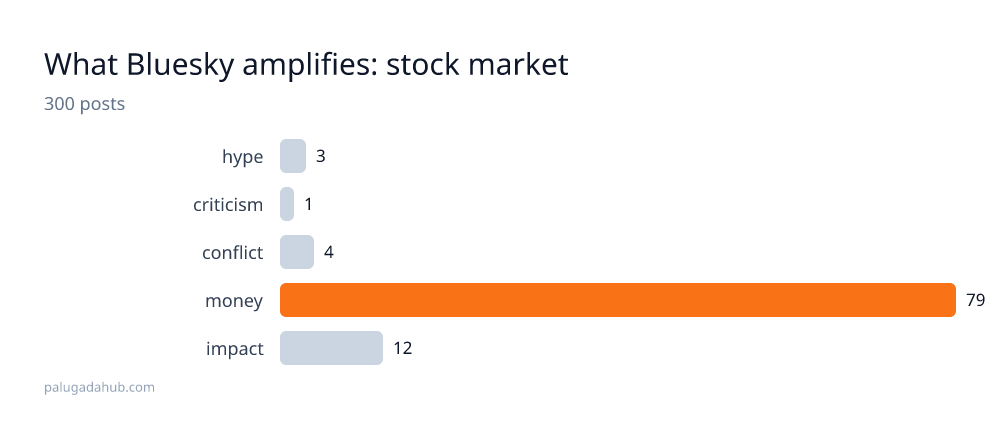
Criticism of the stock market appears regularly on Bluesky. It simply does not travel. Over 14 days, 11 posts framed the market through a critical or backlash lens, roughly 3% of 296 classified posts. Those 11 posts drew only 12 likes, reposts, and replies combined, or 1% of the 1,210 total engagements across the entire sample. By contrast, posts framed around money and business mechanics, earnings, valuations, trading signals, account for 76% of posts and capture 79% of engagement, a near-perfect alignment that suggests the network's default mode is transactional, not interrogative.
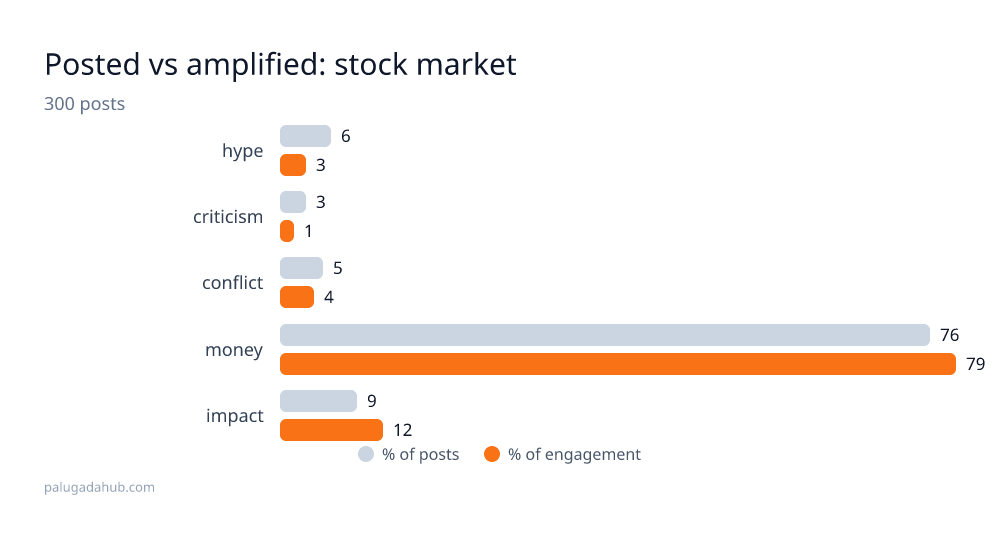
The silence is not accidental. It reflects a structural preference baked into how Bluesky users engage with market content. The comparison below shows the gap:
| Frame | Posts (%) | Engagement Share (%) | Ratio |
|---|---|---|---|
| Criticism / backlash | 3 | 1 | 0.33x |
| Money / business | 76 | 79 | 1.04x |
| Impact / human | 9 | 12 | 1.33x |
| Conflict / power | 5 | 4 | 0.80x |
| Hype / optimism | 6 | 3 | 0.50x |
Criticism underperforms its post share by a factor of three. Even hype and optimism, which might seem like the network's comfort zone, underperform slightly (6% of posts, 3% of engagement). Only human-impact framing, stories about who wins or loses, outperforms its post share (9% of posts, 12% of engagement). The market talk on Bluesky is, overwhelmingly, about how markets work, not whether they should.
The top amplified link illustrates the pattern. CNBC's story about SpaceX buyers being "almost under water after two-day slide" drew 11 engagements, the highest in the sample. That headline contains critical information, a drawdown, a loss, but the framing is descriptive and technical, not judgmental. It reports a fact about price movement, not an indictment of the system. The next most-shared links include a Trump remark on affordability (framed as political conflict, not market criticism) and Ed Zitron on OpenAI's financials (a technical explainer, not a critique of market structure or fairness).
This matters because it shapes what kind of stock-market knowledge circulates on the network. Posts that question market efficiency, critique wealth concentration, or challenge trading practices exist but remain marginal. They are posted into a void. The network's engagement machinery rewards precision over skepticism, mechanics over morality.
Building an AI agent?
I'm packaging how I ship them into one kit. Early access:
AI Agent Starter Kit →