The New York Times Owns Bluesky's Housing Crisis Conversation
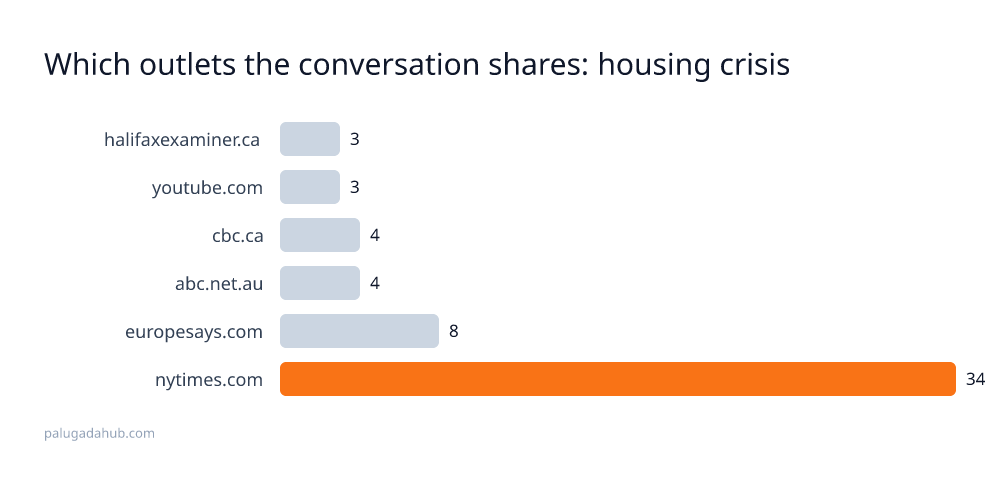
The New York Times dominates what Bluesky users share about the housing crisis. Across 106 posts that included a news link over the past 14 days, nytimes.com appeared 34 times, roughly four times more often than the next-most-shared outlet. No other source came close: europesays.com appeared 8 times, while ABC Australia, CBC Canada, and two Canadian local outlets each showed up 3 to 4 times.
This concentration matters because it narrows the conversation. The Times' editorial voice and reporting priorities set the frame for what the network discusses. When one outlet dominates shared links by a 4-to-1 margin, it is not amplifying a diverse news ecosystem; it is amplifying a single institution's interpretation of the crisis.
| Outlet | Link Appearances | Share of Linked Posts |
|---|---|---|
| nytimes.com | 34 | 32% |
| europesays.com | 8 | 8% |
| abc.net.au | 4 | 4% |
| cbc.ca | 4 | 4% |
| Other outlets | 56 | 53% |
The most-engaged single link, however, came from a different outlet entirely. A Radio New Zealand story about parliamentary scrutiny of social housing drew 114 engagements, more than double the top New York Times link (39 engagements). This suggests that while the Times sets the baseline conversation, the network's highest engagement can spike around stories that offer concrete political accountability or local specificity, not just national opinion.
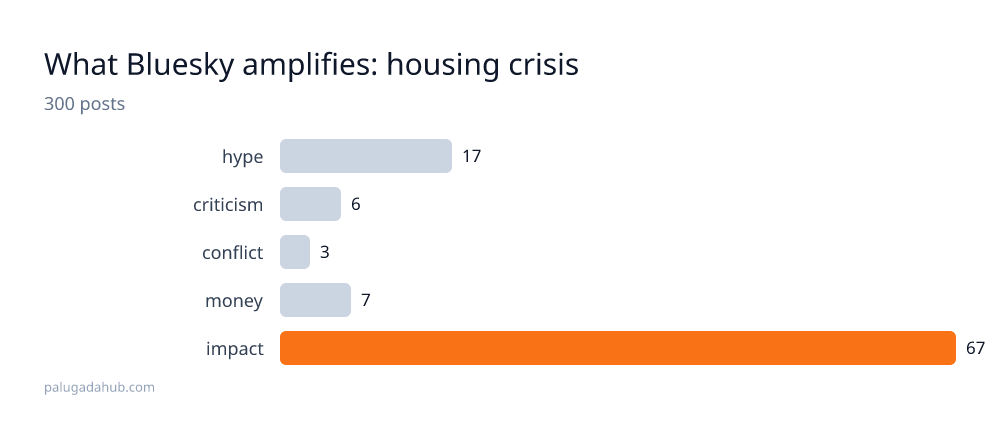
The framing split reinforces this pattern. Across all 300 posts classified by frame, 76% focused on human impact and lived experience. Yet when users share a news link, the conversation does not shift dramatically; 67% of engagement still flows to impact-focused framing. The Times' editorial pieces and reported stories fit this demand for human-centered narratives, but so do local and international outlets when they report on concrete policy fights or individual circumstances.
Why it matters
News concentration on social platforms shapes which stories get repeated, which sources gain authority, and which aspects of a crisis become "the" story. When 32% of shared links come from one outlet, that outlet's reporters, editors, and opinion writers effectively curate the network's understanding of the issue. This is not a conspiracy; it is a natural effect of network effects: the Times' brand recognition, distribution resources, and SEO advantage make its stories easier to find and share.
But it also means that reporting from local outlets, international newsrooms, and specialized publishers gets crowded out, even when it generates high engagement. The RNZ story's 114 engagements suggest appetite for accountability journalism and specific policy detail, yet it appears only once in the dataset. The network may be missing stories that match its own stated preferences.
Who it's for
Journalists and editors at outlets outside the Times will recognize this dynamic: breaking through the noise requires either a story so locally urgent that it spreads despite lower brand visibility, or a partnership or syndication deal that gives it distribution. For Bluesky users interested in housing policy, the concentration means they are seeing one institution's beat and editorial judgment repeatedly, which may limit exposure to alternative angles or evidence.
When and where
This data spans 14 days of English-language posts tagged "housing crisis" on Bluesky, captured via searchPosts and weighted by total engagement (likes, reposts, replies). The 106 posts with news links represent roughly 35% of all posts in the sample. The top-linked outlets skew toward English-language news organizations with established digital presence; smaller outlets and non-English sources do not appear in this sample.
How
The analysis used descriptive statistics to count link appearances by domain across the 106 linked posts, then ranked by frequency. Engagement was summed per link and compared to link frequency to identify cases where high-engagement stories came from less-frequently-shared outlets. The framing comparison used regex classification of post language against predefined frames (impact/human, money/business, conflict/power, criticism/backlash, hype/optimism) and compared post-count distribution to engagement-weighted distribution to detect frame preference shifts when links are present.
One caveat: this sample captures posts that mention "housing crisis" and include a news link; it does not capture the full conversation (300 posts total, 106 with links), and it does not distinguish between posts that endorse a link versus those that critique it. A post sharing a Times story to argue against it still counts as amplifying the Times.
The takeaway
News concentration on social platforms is not new, but it is worth naming plainly. When one outlet's links appear in one-third of shared posts, that outlet is not just reporting the story; it is setting the terms of the debate. The network's stated preference for human-impact framing suggests appetite for stories that connect policy to lived experience, yet that appetite is being funneled through a single institution's reporting. Breaking that pattern requires either competing outlets to reach parity in visibility, or users to actively seek and share stories from elsewhere.
Building an AI agent?
I'm packaging how I ship them into one kit. Early access:
AI Agent Starter Kit →