Conflict Dominates Labor Strike Posts, Then Overwhelms Them
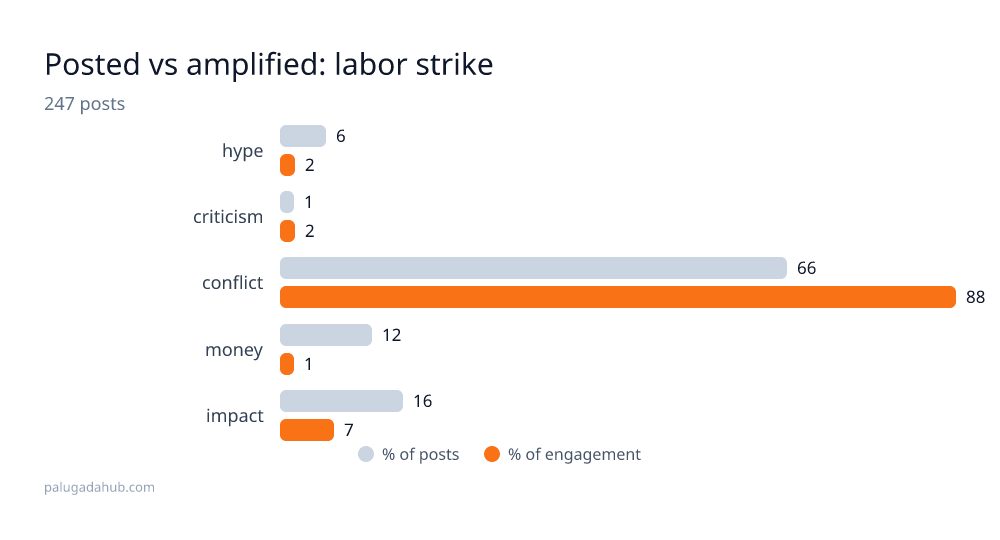
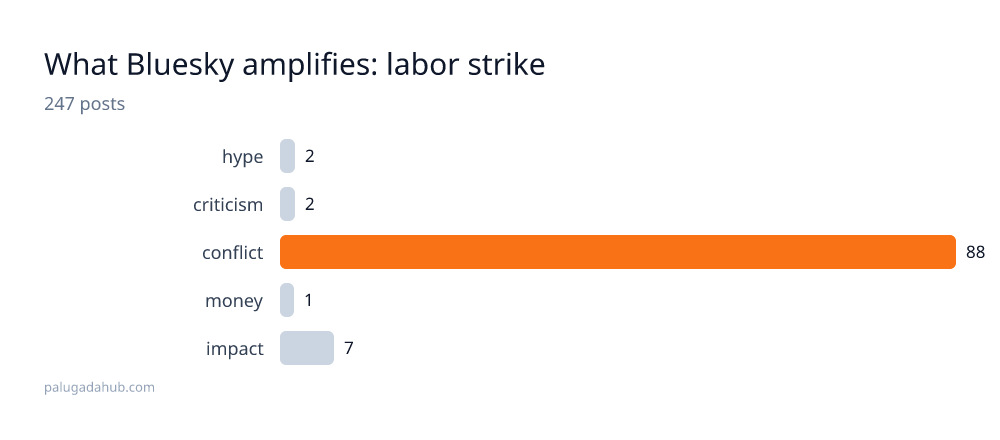
Conflict frames labor strike posts at a 66-to-88 engagement ratio: the network posts one way and boosts another, harder. Across 247 posts over 14 days, the conflict or power struggle narrative dominates both the volume and the amplification, but the gap between them reveals how Bluesky's engagement mechanics reward confrontation over nuance.
The inversion is sharp. Posts tagged as conflict or power represent two-thirds of all labor strike content by count, yet they capture 88% of total engagement (likes, reposts, replies). Every other frame shrinks under amplification. Human impact stories, which make up 16% of posts, earn only 7% of engagement. Business or money frames, 12% of posts, draw just 1% of engagement. Criticism and backlash, 1% of posts, also 2% of engagement. Optimism, 6% of posts, 2% of engagement.
| Frame | Posts | Engagement Share |
|---|---|---|
| Conflict / Power | 66% | 88% |
| Impact / Human | 16% | 7% |
| Money / Business | 12% | 1% |
| Hype / Optimism | 6% | 2% |
| Criticism / Backlash | 1% | 2% |
One story accounts for much of the amplification. A Balls and Strikes article on the Delaney Hall strike, "The Delaney Hall Strike Is Exposing a Massive Thirteenth Amendment Crisis," generated 3,457 engagements in a single post, dwarfing the second-ranked link (250 engagements, the same article reposted). That one piece represents roughly 17% of all engagement in the sample. The Delaney Hall frame, centered on constitutional crisis and state power, is pure conflict. The story spread across labor history podcasts, YouTube, and activist networks, but the engagement concentration on one outlet and one framing suggests the network is not distributing labor strike news broadly, but amplifying a specific confrontational narrative.
Why it matters
The gap between posted and amplified frames shapes what labor strike coverage looks like on Bluesky. If conflict stories earn disproportionate engagement, they attract more posts, more replies, more shares. Frames that emphasize negotiation, worker welfare, or business impact get posted but not boosted. This is not a Bluesky-specific phenomenon, but the scale here is notable: an 88% concentration on conflict, driven by one viral link, means that alternative framings of labor disputes, economic analysis, worker testimony, employer response, settlement prospects, are effectively deprioritized by the network's engagement curve.
For labor journalists and organizers, the implication is clear: conflict and constitutional crisis narratives travel. Human impact stories, which made up 16% of posts, barely register. A post about women on hunger strike at Delaney Hall (Truthout, 33 engagements) sits orders of magnitude below the constitutional framing of the same event.
Who it's for
Labor reporters and editors deciding how to cover strikes. Activist networks using Bluesky to coordinate. Social media researchers studying how platforms amplify or suppress certain frames of economic conflict.
When and where
Data spans 14 days of English-language posts tagged "labor strike" on Bluesky, captured via searchPosts and weighted by engagement. The sample includes 237 posts classified by frame, 66 of which carried a news link. The top-linked domains were labor history podcasts, YouTube, Truthout, La Huelga, and Balls and Strikes.
How
The analysis applied descriptive statistics and frame classification via regex matching on post text and headlines, then weighted each frame by total engagement (likes plus reposts plus replies) to measure the posted-vs-amplified gap. The comparison table shows post share and engagement share side by side, revealing the inversion. One caveat: frame classification is rule-based, not human-coded, so edge cases (e.g., a post that mixes conflict and human impact) may be miscategorized. The engagement weighting treats all three signals (likes, reposts, replies) equally; some platforms weight reposts higher as a signal of reach, but Bluesky's algorithm is not public, so equal weighting is a reasonable baseline.
The takeaway
When one frame dominates both posts and engagement, the gap between them is often the story. Here, conflict is winning on both axes, but the amplification gap shows that Bluesky's network effects are not neutral. They reward confrontation and constitutional stakes over economic detail or worker voice. This pattern may reflect user behavior (conflict posts get more replies), algorithmic design, or both. Either way, labor strike coverage on Bluesky is not a cross-section of labor disputes; it is a curated sample of the most contentious ones.
Building an AI agent?
I'm packaging how I ship them into one kit. Early access:
AI Agent Starter Kit →