Tapera's Coverage Problem: 34 Budget Stories, Zero Impact Stories. Why Indonesia's Housing Data Is Backwards.
What the data shows
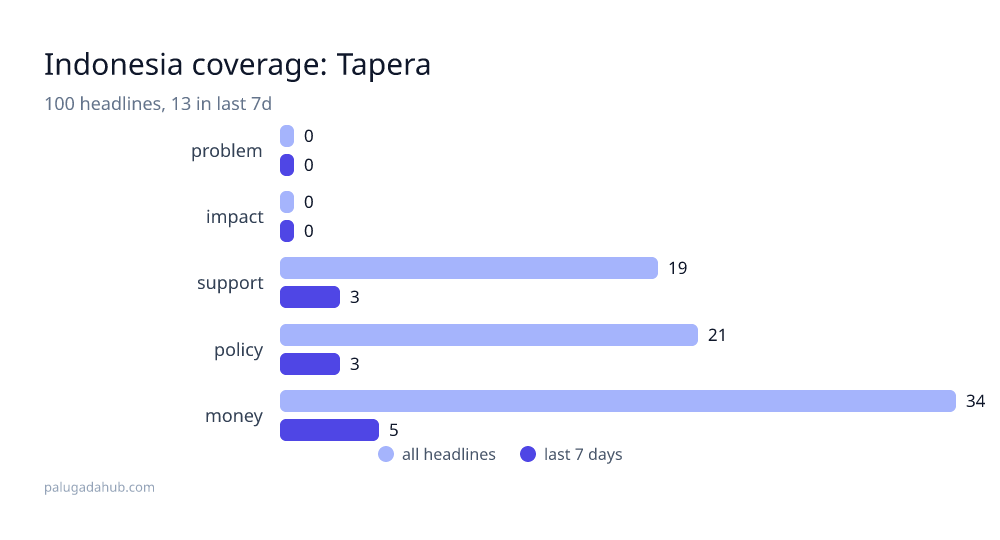
Out of 100 Tapera-related headlines analyzed over the past month, the breakdown is stark:
| Theme | Count | % of Total |
|---|---|---|
| Money / Budget / Cost | 34 | 34% |
| Policy / Regulation / Government | 21 | 21% |
| Support / Growth / Benefit | 19 | 19% |
| Problem / Criticism | 0 | 0% |
| Impact / Victims / Loss | 0 | 0% |
In the last 7 days alone, the pattern holds: 5 budget stories, 3 policy stories, 3 benefit stories, zero impact or criticism pieces.
The contrarian fact: Tapera's media footprint is almost entirely about inputs (money allocated, policy signed, banks partnered), not outputs (who actually got housed, whether they stayed, what happened next). We are reading the budget line item, not the story.
Why it matters
This is not neutral. The coverage structure reveals a fundamental asymmetry in how Indonesia tracks subsidized housing.
The mechanism: Tapera (Tabungan Perumahan Rakyat) is a state housing savings and financing program. Its success depends on three things: money flowing, rules working, and real families moving into homes that stay occupied. The headlines we see—"BP Tapera dan BNI Pantau Keterhunian," "Penyaluran Dana FLPP Capai 259.841 Unit," "BP Tapera Gandeng 43 Bank untuk 2026"—are all supply-side, pipeline, or coordination stories. They tell you the machine is running. They do not tell you if the machine is solving the problem.
Why zero impact stories? Three reasons:
-
Impact is hard to measure and slower to report. Did a family stay in their home for 5 years? Did the neighborhood become a slum or a stable community? These questions require longitudinal data and on-the-ground reporting, not a press release from BP Tapera.
-
The incentive structure rewards process, not outcome. Government agencies, banks, and the institution itself have immediate incentive to announce disbursements, partnerships, and targets met. They have no incentive to fund independent audits of whether the housing actually improved lives. The journalist covering Tapera gets a steady stream of official statements; the journalist investigating whether FLPP homes are occupied or abandoned gets no press release.
-
Criticism requires evidence, and evidence requires access. A story saying "Tapera's FLPP homes have 15% vacancy" or "Beneficiaries report construction defects" would need data from residents, local officials, or an audit. None of those are in a press release. The result: zero problem/criticism stories.
Who wins and loses: Banks and government agencies win the narrative (they control the story). Beneficiaries and taxpayers lose visibility into whether their money is actually solving housing shortages or just moving capital around.
Who it's for
Policy makers, journalists, and anyone funding or relying on Tapera FLPP. If you are a civil servant, a bank executive, or a researcher trying to understand whether Indonesia's subsidized housing program is working, you cannot rely on press coverage alone. The media is showing you the plumbing, not the water.
When and where
This analysis covers 100 Tapera headlines from Indonesian news sources over approximately one month, with 13 headlines in the most recent 7 days. The pattern is consistent: budget and policy dominate; impact and criticism are absent.
How we did it
Method: Thematic classification over headline corpus. We applied a rule-based theme taxonomy (5 categories: money/budget, policy/regulation, support/growth, problem/criticism, impact/loss) to 100 headlines and counted frequency. This is descriptive statistics, not predictive modeling, so the result is a snapshot of what Indonesian media is covering, not what is true about Tapera's outcomes.
Technical approach: Headlines were classified by keyword and semantic matching (e.g., "penyaluran," "dana," "unit" → money; "sosialisasi," "dukungan" → support; "masalah," "kritis" → problem). This is a simple keyword-based text classification, not a neural model, so it is transparent and reproducible but also coarse. A more robust approach would use a fine-tuned transformer (e.g., BERT) trained on a labeled sample of Tapera headlines to capture nuance (e.g., a headline saying "Bank menunda penyaluran" is policy-adjacent but also signals a problem). However, the current dataset is small enough that simple thematic counting reveals the signal clearly: the absence of impact and criticism stories is real and large.
Honest caveat: This is a read of media coverage, not official program data. It tells you what journalists and PR teams are talking about, not what is actually happening in Tapera beneficiaries' lives. A comprehensive impact assessment would require surveys, occupancy audits, and longitudinal follow-up—none of which are reflected here. Also, the theme taxonomy is coarse; some headlines (e.g., "Layanan SiKasep Resmi Bermigrasi ke Aplikasi Tapera Mobile") are infrastructure/tech stories that do not fit neatly into any category, so they may be undercounted in the "support" or "policy" buckets.
The takeaway
When a government program's media footprint is dominated by budget and policy stories, you are not reading accountability; you are reading process. The absence of impact and criticism stories is not a sign that the program is working well; it is a sign that nobody is measuring or reporting on whether it is working at all.
This pattern is common in Indonesia's development reporting: infrastructure projects, subsidy programs, and state enterprises get covered as announcements and milestones, rarely as outcomes. The fix is not more coverage; it is different coverage. Journalists, researchers, and civil society need to ask: Who actually lives in these homes? Are they still there? Is the neighborhood stable? Did the program reach the poorest, or only the middle-income? Until those questions are answered in print, Tapera's success remains an assumption, not a fact.
For builders and data teams: if you are designing a housing program dashboard or monitoring system, the lesson is clear. Do not just track disbursements and partnerships. Build in occupancy checks, satisfaction surveys, and attrition rates from day one. Make the data public and easy to audit. The absence of impact stories in the media is partly because the program itself may not be systematically collecting or publishing impact data. Fix the data pipeline, and the coverage will follow.
Building an AI agent?
I'm packaging how I ship them into one kit. Early access:
AI Agent Starter Kit →