On Bluesky, climate talk is about holding power to account, not growth hype
A few days ago I looked at climate coverage through press headlines and found it skewed toward growth and investment stories. So I asked the opposite question: when real people share climate policy news, what do they actually boost? I pulled the data from Bluesky, where there is no ad-driven feed pushing market PR, and the answer flips.
What the data shows
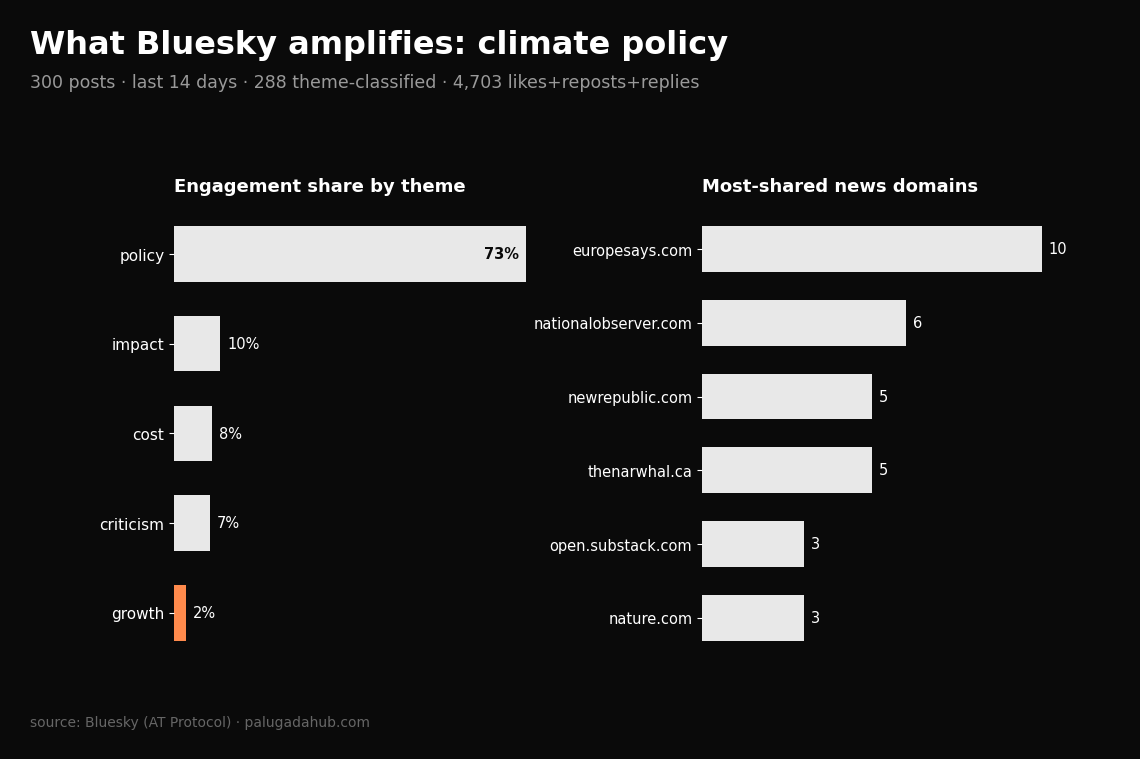
I searched Bluesky for "climate policy" and collected the 300 most recent English posts, spanning the last 5 days (June 14 to 18, 2026). Of those, 288 could be classified into a theme, and 91 carried a shared news link. Then I weighted each theme by engagement (likes, reposts, and replies combined, 4,703 in total) instead of just counting posts, because a post nobody boosts is not really part of the conversation.
| Theme | Posts | Share of engagement |
|---|---|---|
| Policy / governance | 285 | 73% |
| Impact / disaster | 31 | 10% |
| Cost / burden | 32 | 8% |
| Criticism / conflict | 19 | 7% |
| Growth / opportunity | 38 | 2% |
(Themes are multi-label, so a post can sit in more than one. Shares are of total theme-tagged engagement.)
The headline number: growth and opportunity framing, the stuff that dominates press coverage, pulls just 2 percent of engagement here. It gets posted (38 times) but almost nobody amplifies it. The conversation is overwhelmingly about policy and governance, and the sharpest engagement sits on accountability stories.
What people are actually sharing
The most-engaged links make the pattern obvious. The top shared stories by engagement were:
- National Observer, "Mark Carney still cares about climate policy" (482 engagements)
- The Narwhal, "Carney is shredding environmental rules and misleading the public" (335)
- National Observer, "Carney government faces first lawsuit over its climate policies" (37)
The most-shared news domains were europesays.com (10 posts), nationalobserver.com (6), newrepublic.com (5), and thenarwhal.ca (5). This is accountability journalism, not market forecasts. A government walking back climate rules, a lawsuit, a charge of misleading the public.
Why it matters
Same topic, opposite frame, depending on where you look. Press headlines amplify what attracts investment and makes good announcements. A community network with no growth-PR incentive amplifies who is being held responsible. Neither is the whole truth, but the gap is the story. If you are a comms team wondering why a polished "green growth" message lands flat with engaged audiences, this is why. The people actually sharing climate news are tracking power, not opportunity.
Who it is for
Climate communicators, journalists, and anyone trying to read where the real conversation sits rather than where the press release sits.
How I analyzed it
Source: Bluesky via the AT Protocol searchPosts endpoint, pulled live. Method: regex theme classification on post text into five buckets (policy, impact, cost, criticism, growth), multi-label. Engagement weighting sums likes, reposts, and replies per theme. News links and domains come from each post's external embed. Every percentage above is over a stated count, no hidden denominators.
Honest caveats. Bluesky is not the public. Its userbase skews technical, English-speaking, and politically progressive, so accountability framing is exactly what you would expect it to over-index on. The window is short (5 days) and one news event, Canada's Carney government rolling back environmental rules, dominates this snapshot, so the Canadian tilt is real. Engagement weighting also rewards a few viral posts. This is a clear signal about one network in one week, not a claim about global opinion.
The takeaway
The "climate coverage is obsessed with growth" pattern is a property of press headlines, not of how engaged people actually talk. Strip out the algorithmic and PR incentives, and the climate conversation becomes an accountability fight. If you only read the headlines, you miss half of it. The next question is whether that gap holds across topics, or whether climate is special because the stakes are so clearly about who wins and who pays.
Building an AI agent?
I'm packaging how I ship them into one kit. Early access:
AI Agent Starter Kit →