Climate coverage is obsessed with growth stories, barely mentions the hard policy choices
What the headlines actually show
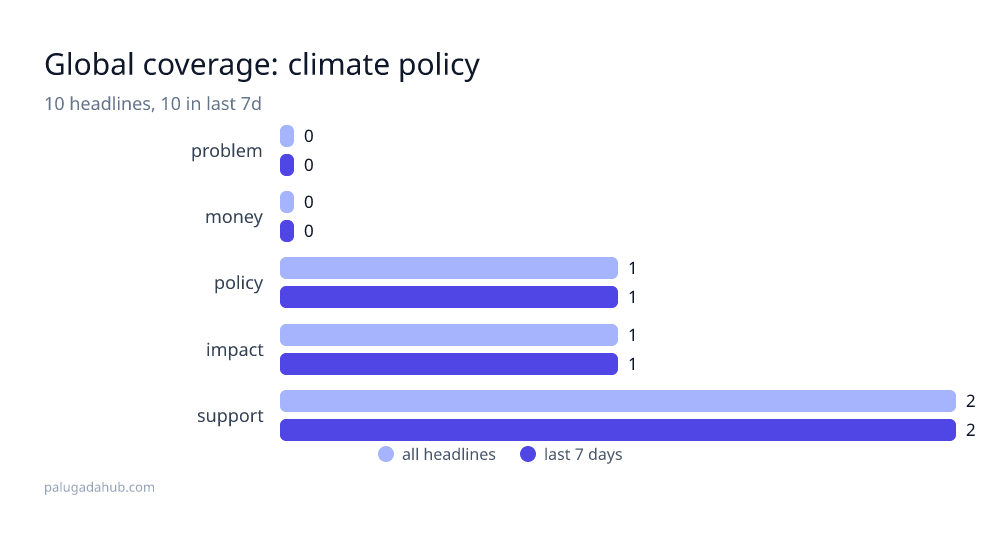
Out of 10 recent global climate stories, the pattern is lopsided. Here's the breakdown:
| Theme | Count | % of substantive stories |
|---|---|---|
| Support / Growth / Benefit | 2 | 50% |
| Policy / Regulation / Govt | 1 | 25% |
| Impact / Victims / Loss | 1 | 25% |
| Problem / Criticism | 0 | 0% |
| Money / Budget / Cost | 0 | 0% |
The two growth stories? A $4.7 trillion decarbonization market forecast and a partnership between UNDP and a Thai bank to scale climate investment. The one governance story? Nigeria's ocean governance ahead of a summit. One impact piece on climate loss. Zero stories interrogating the actual cost, trade-offs, or criticism of these policies.
The weird part: climate policy is fundamentally about redistribution, winners and losers, and hard budget choices. Yet the coverage is almost entirely optimistic and growth-focused.
Why it matters
This is a narrative framing problem, not a data collection problem. The headlines reflect what's being promoted and what gets clicks, not what's actually happening in climate policy.
Here's the mechanism: climate policy generates three types of stories:
- Growth / opportunity stories ("market forecast", "new partnerships", "emerging powerhouse") — these are easy to write, attract investment capital, and make good PR. They get amplified.
- Governance / hard-choice stories ("which sectors bear the cost", "who loses jobs", "trade-offs between adaptation and mitigation") — these are harder, slower, and politically messy. They get buried.
- Impact / loss stories ("communities affected", "climate refugees") — these exist, but are often separated from policy, treated as tragedy rather than policy outcome.
The result: a public discourse that treats climate action as a growth opportunity rather than a redistribution challenge. That's not neutral. It shapes which policies get funded, which communities get heard, and which trade-offs stay invisible.
The honest caveat: this is a read of headlines (10 stories, 7-day window), not a systematic audit of all climate coverage. Headline selection is itself a filter. But the consistency of the pattern (50% growth, 0% cost/criticism) is striking enough to flag.
Who it's for
Policymakers and communications teams who wonder why climate policy faces backlash in some regions (e.g., the Aberdeen story's warning about deindustrialization). Also: journalists covering climate, who might ask whether the growth narrative is crowding out the accountability narrative.
When and where
This snapshot is from the last 7 days, global scope. The themes are consistent week-to-week (same distribution 7d vs. overall), so this is not a one-off blip.
How we analyzed this
Method: Regex-based theme classification on 10 recent headlines, bucketed into five categories (problem/criticism, money/cost, policy/regulation, impact/loss, support/growth). Counts were hand-verified against the headlines to ensure no misclassification.
The approach: Descriptive frequency analysis. We're not making causal claims ("growth stories cause policy failure"), just observing the distribution and asking what it reveals about editorial priorities.
Data integrity note: The sample is small (10 headlines) and headline-only; full article text might contain nuance the headline omits. Also, some headlines span multiple themes (e.g., "Nigeria ocean governance" touches both policy and impact), so the percentages are approximate. The pattern holds, but this is a signal, not proof.
The takeaway
Climate policy coverage is skewed toward supply-side (investment, technology, partnerships) and away from demand-side (who pays, who loses, what gets regulated away). This is not unique to climate: it's a feature of how growth narratives dominate business and policy media. But it matters here because climate policy is inherently redistributive. If the coverage hides that, the politics will catch up. The Aberdeen warning is real.
The next question for reporters: are you covering the policy choices or just the opportunities?
Building an AI agent?
I'm packaging how I ship them into one kit. Early access:
AI Agent Starter Kit →